Bubbles 10015 Makes History: Rookie All-Star at DCMP, Headed to Worlds
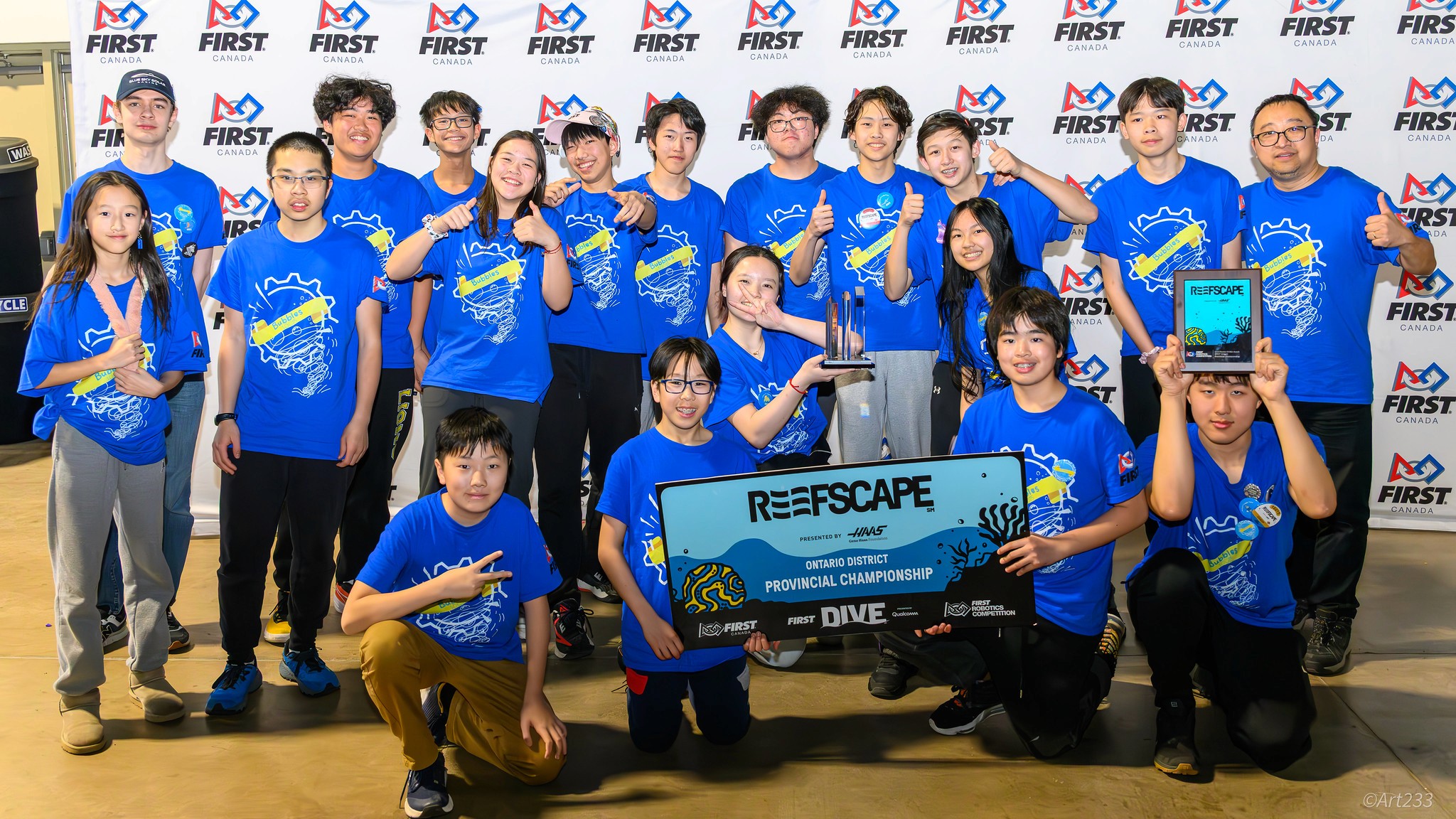
FRC Team 10015 Bubbles earned the 2025 Ontario District Championship Rookie All-Star Award and qualified for the FIRST Championship in its first season. With few technical mentors, the young Aurora team relied on years of FIRST LEGO League experience, self-directed learning, an original bio-inspired spiral arm, extensive FIRST outreach, and authentic student ownership to build both a robot and a sustainable future (FRC-Event).
By SolversMind Robotics
Published April 5, 2025 | Updated July 22, 2026
Reviewed by SolversMind Robotics mentors
How did FRC Team 10015 Bubbles reach the FIRST Championship in its rookie season?
FRC Team 10015 Bubbles earned the District Championship Rookie All-Star Award at the 2025 FIRST Ontario Provincial Championship, qualifying for the FIRST Championship during its first FRC season. The achievement was remarkable because the young community team had few experienced technical mentors and almost no direct help developing its robot. Instead, students relied on their FIRST LEGO League foundation, began studying FRC design immediately after completing their final FLL season, and took ownership of mechanical development, programming, testing, outreach, strategy, and team operations. Their robot was not among Ontario’s highest-scoring machines, but judges recognized something deeper: a team with authentic student work, a clear sustainability plan, strong FIRST values, an original bio-inspired mechanism, and the potential to become what one judge called a “future powerhouse.” The award confirmed that Bubbles had built more than a rookie robot. It had built the foundation of a lasting student-led team.
History had been made.
Only months earlier, the students were still trying to understand how an FRC robot should be structured. Now they were standing at the Ontario District Championship, hearing their team number called and realizing that they were going to Houston.
The official award script celebrated a “young but strong partnership effort” and highlighted the team’s FLL roots, mentorship of four younger teams, fundraising structure, succession planning, and commitment to the mission of FIRST.
Award Script
The Rookie All-Star Award celebrates the rookie team exemplifying a young but strong partnership effort, as well as implementing the mission of FIRST to inspire students to learn more about science and technology.
This team of FLL veterans forged strong bonds and overcame numerous challenges throughout their rookie year. By reflecting on their journey, this team effectively showcased their fundraising structure, established a solid succession plan, and secured their future by returning to their roots and continuing the mentorship of 4 FLL teams. In fueling dreams and shaping futures, this team really BUBBLED… up to the top.
Congratulations Team 10015!
For the students, the announcement felt almost impossible.
They had not entered the season with years of FRC experience, a deep mentor bench, or an established library of previous robots. They had entered with curiosity, courage, and a clear goal.
They wanted to prove that young students could build something meaningful when they were trusted to own the journey.
How did a young team overcome its lack of technical mentors?
Bubbles began its rookie year without the technical support structure available to many established FRC teams.
There were no generations of alumni engineers waiting to provide proven designs. There was no large group of specialized mentors for mechanical systems, controls, electronics, manufacturing, and competition strategy. When students encountered a problem, they often could not simply turn to an experienced adult for the answer.
They had to find it themselves.
“What makes this so special,” said coach Mr. Dahai Zhang, “is that these students built everything from scratch—robot, team culture, and strategy. And now they’re going to Worlds in their very first year.”
The team’s preparation had actually started before its official rookie season. As soon as the students completed their FIRST LEGO League journey in February 2024, they began studying FRC robot architecture, mechanisms, programming systems, competition videos, technical documentation, and the work of experienced teams.
They knew where they wanted to go.
That clear goal changed how they learned.
Years of FLL had already taught the students how to divide a complex challenge into smaller problems, test ideas repeatedly, communicate under pressure, and continue after failure. FRC was much larger and more demanding, but the learning process was familiar.
The students researched drivetrains, motors, gearboxes, elevators, sensors, vision systems, autonomous programming, wiring, and game strategy. They watched how established teams approached design. They asked questions at competitions. They studied robots in the pits. They absorbed advice through the culture of Gracious Professionalism and then returned to Aurora to apply what they had learned.
Being short of mentors made the journey harder, but it also made ownership unavoidable.
When the robot failed, the students had to diagnose it.
When a mechanism broke, they had to repair it.
When code behaved unpredictably, they had to trace the problem.
When a design proved too heavy, too weak, or too complicated, they had to accept that the idea was not working and begin again.
Coach Dahai Zhang later reflected that the students had “built everything from scratch”, including the robot, team culture, and strategy.
That was the real story behind the award.
Bubbles did not arrive fully prepared.
The students became prepared because the challenge gave them no other choice.
Why was Bubbles’ bio-inspired spiral arm so innovative?
Bubbles wanted its first robot to include an idea that reflected curiosity, research, and a willingness to explore beyond conventional FRC mechanisms.
The inspiration came from the scientific paper SpiRobs: Logarithmic Spiral-Shaped Robots for Versatile Grasping Across Scales. The research described soft robots based on logarithmic spiral forms found in natural appendages such as octopus arms and elephant trunks. These cable-driven structures can curl around objects and adapt to a wide range of shapes and sizes.
The students asked whether this emerging soft-robotics concept could be adapted for the demands of a FIRST Robotics Competition game.
Their answer became Octo-Master, a flexible, bio-inspired spiral arm created from modular 3D-printed TPU segments and driven through cable actuation.
Instead of requiring perfect alignment, the arm could wrap around a game piece, conform to its shape, and maintain contact as the robot moved. This gave the mechanism a different form of intelligence. Adaptability came partly from the geometry and material itself, rather than only from sensors and software.
To the team’s knowledge, it was the first logarithmic spiral soft arm applied as a functional FRC competition mechanism.
The students did not produce the final design in one attempt.
They created three major versions before the Ontario Provincial Championship.
The first version proved that the principle could work, but revealed problems with strength, actuation, mounting, and repeatability.
The second version incorporated lessons from testing and conversations with other FRC teams. It became more durable and controllable, but still required refinement.
The third version improved the structure, modularity, motor system, and practical integration with the full robot.
Each version carried evidence of what the students had learned.
They did not simply copy a scientific paper. They translated a research concept into a competition mechanism operating under strict limits for size, weight, impact, speed, and reliability.
The robot reveal also attracted attention beyond the team. The Octo-Master teaser was featured by FUN Robotics Network as the only rookie-team robot and the only Canadian robot in that showcase.
For a new team from Aurora, that recognition mattered.
Before Bubbles had established a long competition history, its students had already contributed an idea that made the wider FRC community stop, look, and ask questions.
Why did judges see Bubbles as more than a rookie robot?
Bubbles’ robot was innovative, but it was not a top-tier scoring machine at the Ontario District Championship.
The students knew that.
They could see the speed, reliability, and scoring ability of Ontario’s most experienced teams. They understood how much more they still needed to learn.
That made the Rookie All-Star Award more meaningful, not less.
Judges were evaluating whether Bubbles had the foundations of a sustainable and impactful FIRST team. They looked beyond a single match result and examined the students’ technical ownership, outreach, team structure, leadership, succession planning, growth, and understanding of the FIRST mission.
The students’ FLL history was central to that story.
They had not abandoned the younger students after moving into FRC. They continued mentoring four FLL teams, transferring knowledge back into the program that had first developed them. The team was building a pathway in which students could begin with LEGO robotics, progress into advanced engineering, and later return as mentors and role models.
Bubbles also represented FIRST Robotics Canada through numerous ambassador and outreach opportunities. Students demonstrated robots, spoke with families, supported events, introduced younger children to FIRST, and learned to represent not only their own team but a much larger community.
The team’s outreach did not feel separate from engineering.
Both required students to understand their work, communicate clearly, take responsibility, and serve others.
Through the season, judges began to see Bubbles as a rookie team already developing qualities associated with Impact Award-level organizations: a sustainable pipeline, measurable community engagement, student leadership, knowledge transfer, and a mission extending beyond competition.
The award did not say that Bubbles had already reached the final destination.
It said the students were building in the right direction.
They had created a team with a reason to exist beyond one robot and one season.
How did Ryan Zhang turn individual ownership into team knowledge?
At the centre of Bubbles’ rookie development was team captain Ryan Zhang.
Ryan was still a Grade 9 student, yet he carried primary responsibility for much of the robot’s development. Based on the team’s internal accounting, he completed or directly led close to 90% of the early robot design, programming, integration, troubleshooting, and testing work.
That number reflected both his extraordinary motivation and the reality of a young team that did not yet have enough experienced students to distribute every technical responsibility evenly.
Ryan’s foundation had been built through years of FIRST LEGO League. He understood autonomous programming, iterative design, competition strategy, presentations, research, and the discipline required to continue testing when a solution did not work.
FRC demanded much more.
He had to learn full-size robot software, motor control, system integration, vision processing, sensors, electrical architecture, mechanism coordination, and how small decisions in one subsystem could affect the entire machine.
There were moments when the responsibility was overwhelming.
A robot built by one capable student is not yet a sustainable team.
Ryan gradually learned that leadership was not measured by how much he could complete alone. It was measured by how much knowledge he could transfer to others.
He began documenting systems, explaining code, teaching teammates how mechanisms worked, involving younger members in repairs, and giving others increasing responsibility during testing and competition.
The robot therefore became more than evidence of Ryan’s technical ability.
It became the starting point for a team-wide learning system.
The same students who initially watched him solve problems began to diagnose failures, operate equipment, change components, understand software, and explain the robot to judges.
This transition was essential to the team’s Rookie All-Star recognition.
Judges were not looking for one exceptional student surrounded by helpers. They were looking for a team capable of growing, transferring knowledge, developing successors, and sustaining itself after its founding members graduated.
Ryan’s most important achievement was not that he had built so much of the first robot.
It was that he began turning what he knew into knowledge the entire team could own.
Why did this moment mean so much to the students?
The path to the Ontario District Championship had been filled with uncertainty.
At the beginning, the students did not know whether their robot would be competitive.
They did not know whether the bio-inspired arm would survive contact on an FRC field.
They did not know whether months of self-directed learning would be enough.
They did not know whether judges would understand the meaning behind an imperfect rookie robot.
Then their team number was called.
In that moment, every failed print, broken part, late-night debugging session, uncomfortable presentation, difficult conversation, and uncertain decision became part of something larger.
The award did not erase the weaknesses of the robot.
It gave meaning to the students’ growth.
Bubbles had already won the Newmarket District Event with Teams 4946 and 5409, earned Rookie All-Star at Newmarket, and received the Judges’ Award at Durham. At the Ontario District Championship, the team qualified for Houston through the District Championship Rookie All-Star Award. FIRST’s official records confirm the team’s five awards and championship qualification during its 2025 rookie season (FRC-Event).
The students were not going to Worlds because everything had gone perfectly.
They were going because they had responded to imperfection with courage, learning, teamwork, service, and continued effort.
That is where miracles happen.
Not when a perfect robot appears without struggle.
Not when adults remove every obstacle.
Not when success is guaranteed.
Miracles happen when young people are given a goal that feels beyond their current ability, then trusted long enough to grow into the people capable of reaching it.
Bubbles entered its rookie season as a group of FLL students with a dream.
They left the Ontario Championship as representatives of Canada, headed to the largest FIRST stage in the world.
The robot had carried them there.
But the students they had become were the real achievement.
CLICK HERE FOR MORE PHOTOS
Tags:
FRC Team 10015, FRC Bubbles, Rookie All-Star Award, FIRST Ontario, Ontario Provincial Championship, FIRST Championship, Student-Led Robotics, Aurora Robotics, Ryan Zhang, spiral soft robotic arm, Bio-Inspired Engineering