Bubbles Wins Fan Favourite Award at the 2025 STEMley Cup Overtime Sunday
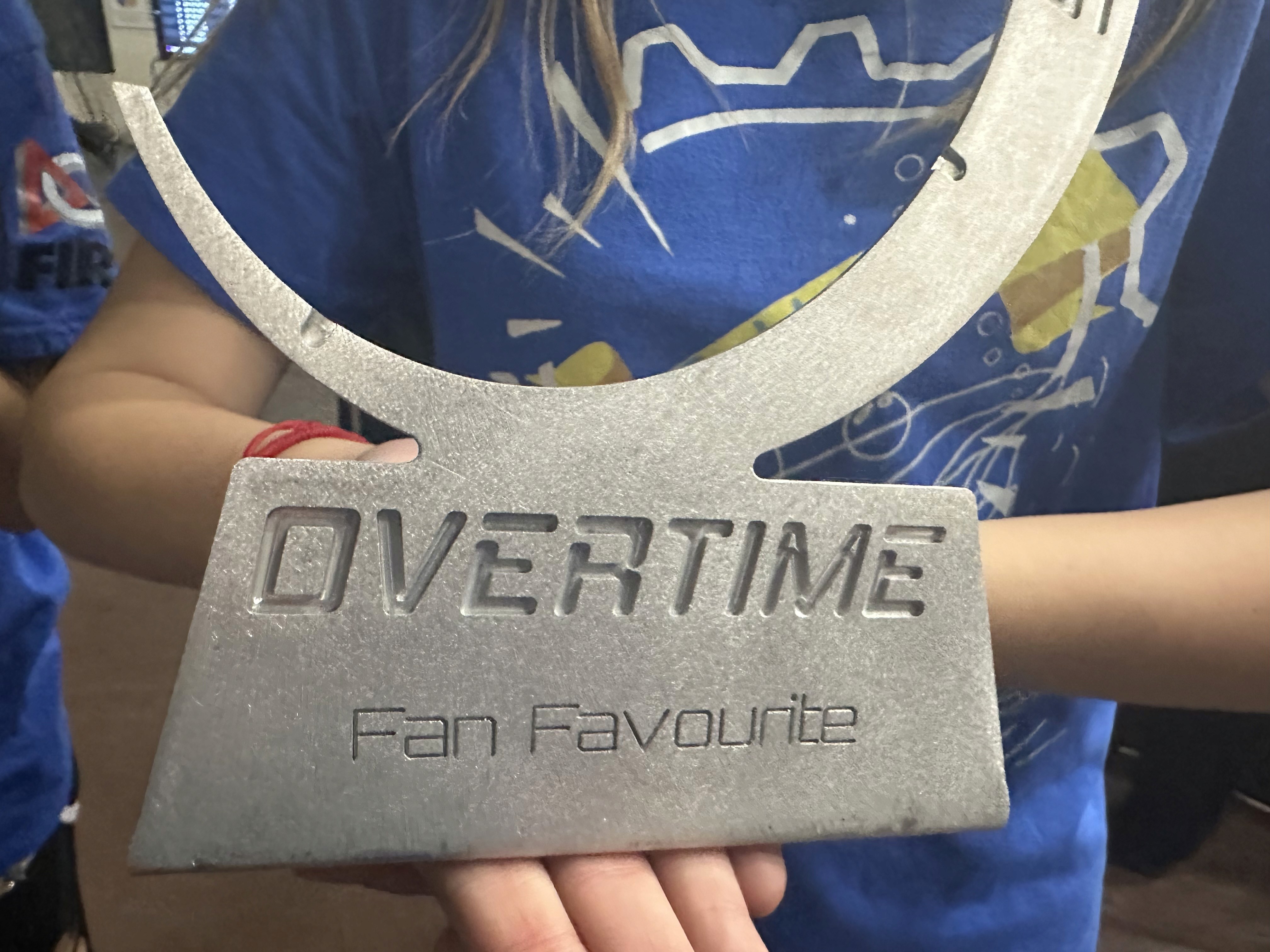
FRC Team 10015 Bubbles won the Fan Favourite Award at the 2025 STEMley Cup Overtime Sunday in Hamilton. After rebuilding its robot for the fourth time, the young Aurora team demonstrated a new elevator capable of scoring both coral and algae, competed in the playoffs, and earned recognition from fellow FRC teams for its student-led engineering, perseverance, and team spirit (STEMley Cup).
By SolversMind Robotics
Published November 2, 2025 | Updated July 22, 2026
Reviewed by SolversMind Robotics mentors
How did FRC Team 10015 Bubbles become a Fan Favourite at STEMley Cup?
FRC Team 10015 Bubbles won the Fan Favourite Award at the 2025 STEMley Cup Overtime Sunday after demonstrating a fourth-generation, student-built robot and a culture of continuous improvement. Following an extraordinary rookie season that included competing at the FIRST Championship and earning the World Rookie All-Star Award, the Aurora team chose not to stop developing. Its students redesigned, rebuilt, and reprogrammed the robot, adding an elevator capable of scoring both coral and algae in the 2025 REEFSCAPE game. Bubbles competed as part of the sixth-seeded alliance and advanced through multiple playoff rounds before its run ended. More importantly, the team earned the votes and respect of other FRC teams attending the event. The award recognized not only the robot’s performance, but also the students’ technical ownership, perseverance, energy, teamwork, and willingness to keep learning after an already successful rookie season.
What is the STEMley Cup?
The STEMley Cup Championship is an offseason FIRST Robotics Competition event hosted in Hamilton, Ontario, by FRC Team 4039 MakeShift Robotics and FRC Team 5406 Celt-X.
Unlike regular-season district competitions, offseason events allow teams to continue operating, testing, and improving their robots after the official competition season has ended. They also create additional opportunities for new drivers, programmers, technicians, and student leaders to gain experience in a competitive environment.
The 2025 STEMley Cup and Overtime Sunday events were held at St. Mary Catholic Secondary School in Hamilton on November 1 and 2. Each event included qualification matches, alliance selection, playoffs, and awards.
STEMley is especially valuable because it brings together established Ontario FRC teams, emerging teams, international participants, volunteers, mentors, and students who want to continue learning beyond the official season.
Why did Bubbles return to competition after its successful rookie season?
Bubbles had already completed an extraordinary first year in FIRST Robotics Competition.
During its rookie season, the team competed at the FIRST Championship and earned the World Rookie All-Star Award. Those achievements could easily have encouraged the students to pause, celebrate, and continue using the same robot without major changes.
Instead, the team recognized that success did not mean its engineering journey was complete.
The students understood that their knowledge of FRC robot design, manufacturing, programming, controls, strategy, and system integration was still developing. More experienced teams had spent many years refining their processes, building institutional knowledge, and learning how to produce increasingly reliable machines.
Bubbles wanted to close that experience gap.
The team returned to its workshop with a simple message:
We are here to learn, challenge ourselves, and keep growing.
That decision reflected one of the team’s most important values. Past awards should not become a reason to stop improving. They should create the confidence and responsibility to attempt something harder.
What was different about Bubbles’ fourth-generation robot?
For Overtime Sunday, the students brought the fourth major version of their FRC robot.
Rather than making only cosmetic adjustments, they redesigned, rebuilt, and reprogrammed significant parts of the system. The most visible upgrade was a new elevator mechanism capable of handling both major REEFSCAPE game pieces:
coral
algae
The development represented a substantial expansion of the robot’s capabilities.
Designing an elevator for an FRC robot requires students to consider structure, weight, stability, motor selection, gear reduction, electrical load, control logic, sensor feedback, extension limits, game-piece handling, and integration with the rest of the machine.
Adding a new mechanism also affects the robot’s centre of gravity, driving behaviour, wiring, software architecture, autonomous routines, and competition strategy.
The fourth-generation robot was therefore more than an attachment placed onto an existing machine.
It represented another complete cycle of engineering analysis, prototyping, manufacturing, programming, integration, testing, failure, and improvement.
Why was rebuilding the robot important for student development?
Students learn the most when they are responsible for solving problems whose answers are not already known.
Using the same robot throughout the offseason would have allowed the team to practise driving and refine small details. Rebuilding it created a much larger educational challenge.
The students had to ask:
Which parts of the previous robot worked well?
Which systems limited scoring or reliability?
How could one mechanism handle two different game pieces?
What structural changes were required?
How would the new elevator affect robot balance?
Which components could be reused?
Which software needed to be rewritten?
How could the new system be tested safely?
What should be changed when the first design did not work?
These questions forced the team to develop a deeper understanding of the entire robot.
The students were not merely learning how to operate a finished machine. They were learning how mechanical, electrical, programming, and strategic decisions influence one another.
How did Bubbles perform at Overtime Sunday?
Bubbles competed against a field of 27 teams at the 2025 Overtime Sunday event in Hamilton (FRC-Event).
Following qualification matches and alliance selection, Team 10015 joined Alliance 6 alongside FRC Team 1360 Orbit Robotics and FRC Team 2702 Rebels.
The alliance lost its opening playoff match by a score of 186–161, but remained in the double-elimination tournament. It then recovered with consecutive victories, winning 177–160 and 145–113 before its playoff run ended later in the bracket.
Those results showed that the rebuilt robot could contribute in a competitive playoff environment.
However, the day’s most meaningful recognition did not come from the match standings.
It came from the other teams.
What is the STEMley Fan Favourite Award?
The STEMley Cup’s offseason awards are voted on by the teams attending the event.
At the 2025 Overtime Sunday award ceremony, FRC Team 10015 Bubbles was named the Fan Favourite, described by the event as the voters’ choice.
That made the award especially meaningful.
It was not based only on one match, one scoring statistic, or one judge’s evaluation. It reflected how the broader event community experienced the team throughout the day.
Other teams saw the robot.
They saw the students working in the pit.
They saw the energy surrounding the team.
They saw how Bubbles competed, communicated, recovered from setbacks, and continued supporting one another.
For a student-led team, recognition from fellow FRC teams is one of the strongest confirmations that its culture and work have been noticed.
Why did the Fan Favourite Award mean so much to Bubbles?
The award showed that the FRC community recognized more than a machine.
People saw the effort behind it.
They saw students who had already completed an exceptional rookie season but still returned to rebuild their robot rather than settle for what they had achieved.
They saw a young team willing to expose an unfinished design to competition, learn from its weaknesses, and continue improving in public.
They also saw students taking genuine responsibility for the robot’s mechanical development, programming, troubleshooting, operation, and presentation.
For Bubbles, the Fan Favourite Award confirmed that technical ambition and team culture can be visible to others.
A robot may attract attention because of what it does on the field.
A team becomes memorable because of how its members work, respond to difficulty, support others, and represent their values.
What did the award demonstrate about authentic student work?
Bubbles is built around a student-work model.
Students are expected to understand their robot, participate directly in its development, explain their decisions, identify failures, and contribute to improvements.
Adult mentors provide safety oversight, professional guidance, questions, resources, and technical support. They do not replace the students as the primary owners of the work.
The fourth-generation robot provided visible evidence of this philosophy.
The students were not simply maintaining a machine produced during the regular season. They had chosen to redesign its systems, add new capabilities, rewrite software, and test their own ideas.
At Overtime Sunday, they had to operate and repair what they had built.
That experience creates a level of technical understanding that cannot be developed by following prepared instructions alone.
The Fan Favourite Award suggested that other teams noticed this ownership and respected the determination behind it.
How does continuous rebuilding prepare students for future FRC seasons?
Every robot version creates new knowledge.
Students learn which materials bend, which fasteners loosen, which motors overheat, which measurements matter, which control settings improve stability, and which mechanisms become difficult to repair during a competition.
They also learn how long manufacturing takes, where communication breaks down, how software and hardware teams should coordinate, and which decisions should be made earlier in the design process.
This knowledge becomes especially valuable when the next FRC season begins.
At Kickoff, every team receives a new game challenge and has only a limited period to design and build a competitive robot. Teams that have practised designing, rebuilding, and integrating systems during the offseason are better prepared to make strong decisions under that pressure.
Bubbles’ fourth robot was therefore not only an attempt to improve its REEFSCAPE performance.
It was preparation for the team’s future.
What role did perseverance play in the team’s result?
Rebuilding a robot rarely follows a perfect plan.
Parts may not fit.
Mechanisms may be heavier than expected.
Software may behave differently on the complete robot than it did during isolated testing.
A system that works slowly in the workshop may fail when operated repeatedly at competition speed.
The students had to accept that some ideas would not work the first time.
Perseverance did not mean repeating the same action indefinitely. It meant examining evidence, identifying the cause of a problem, making an informed change, and testing again.
That process is central to engineering.
It is also central to the team culture Bubbles wants its students to develop.
The robot that appeared at STEMley was not the result of avoiding mistakes.
It was the result of continuing to learn from them.
How did other FRC teams support Bubbles?
Bubbles’ growth was strengthened by the support of more experienced teams and mentors within the Ontario FRC community.
The team expressed particular gratitude to:
FRC Team 3683 Team DAVE
FRC Team 1325 Inverse Paradox
FRC Team 4039 MakeShift Robotics
These teams shared guidance, encouragement, technical knowledge, and examples of strong FRC culture.
MakeShift Robotics has served as an important mentor team for Bubbles, helping its students better understand the expectations, challenges, and possibilities of FIRST Robotics Competition.
This support reflects the culture of Gracious Professionalism found throughout FIRST.
Teams compete intensely on the field, but they also share knowledge, lend parts, solve problems together, and help younger teams become stronger.
Bubbles’ student ownership does not mean students must learn in isolation.
It means they receive guidance from the community and then take responsibility for applying that knowledge themselves.
Why are offseason competitions valuable for young FRC teams?
Offseason events offer a different type of learning from the official competition season.
Students can take on unfamiliar roles with less pressure. A new driver can gain match experience. A developing programmer can test new autonomous routines. Mechanical students can evaluate redesigned mechanisms. Younger members can learn pit procedures, scouting, strategy, and communication.
Teams can also experiment more boldly.
During a regular qualifying event, reliability and district ranking points may discourage teams from making large last-minute changes. During the offseason, the educational value of testing a new design may be more important than the final ranking.
For Bubbles, Overtime Sunday provided an opportunity to test the fourth-generation robot under real match conditions.
The students learned which improvements succeeded, which weaknesses remained, and what knowledge they needed to carry into the next season.
How does this achievement reflect the SolversMind philosophy?
At SolversMind Robotics, students are not trained only to produce an impressive final result.
They are trained to understand the process behind it.
Students are expected to investigate problems, study technical principles, propose solutions, manufacture components, program systems, test repeatedly, and explain what they have learned.
The mentor’s role is not to create a robot on behalf of the students.
The mentor’s role is to establish a safe environment, provide appropriate guidance, ask difficult questions, and give students the responsibility needed to become capable engineers and leaders.
Bubbles’ fourth-generation robot reflected this philosophy.
So did the team’s decision to return to competition after a successful rookie season.
The students could have protected their previous success.
Instead, they accepted the risk of rebuilding because they understood that long-term growth requires new challenges.
Why did this result represent more than another award?
Awards are meaningful, but the most important outcome of Overtime Sunday was the development behind the award.
The students expanded their understanding of robot architecture.
They experienced the consequences of design decisions.
They improved their ability to integrate mechanical and software systems.
They competed through both victories and losses.
They received support from experienced teams.
They also discovered that the wider FRC community valued their effort and identity.
The Fan Favourite Award became a symbol of that journey.
It recognized a team willing to keep working after success, a robot built through repeated learning, and a group of young people who brought energy and courage to the event.
What comes next for FRC Team 10015 Bubbles?
STEMley Cup Overtime was not the conclusion of the team’s development.
It was another stage in a longer process.
The students returned from Hamilton with additional match experience, technical evidence, new questions, and a clearer understanding of what would be required in future FRC seasons.
They also returned with renewed confidence.
Their fourth-generation robot had competed in the playoffs.
Their work had been recognized by other teams.
Their culture had been seen.
Bubbles became a Fan Favourite, but the team’s real victory was proving that a young, community-based, student-led FRC team could continue rebuilding, learning, and rising after an already historic rookie season.
The message remained simple:
Keep learning. Keep rebuilding. Keep growing.
Tags:
FRC Team 10015, Bubbles, STEMley Cup, Overtime Sunday, Fan Favourite Award, Ryan Zhang, FIRST Robotics Competition, Student-Led Robotics, MakeShift Robotics, SolversMind Robotics, Aurora Robotics, York Region Robotics