Is That a Failure? Bubbles’ First Offseason Competition Becomes a Lesson in Engineering Growth
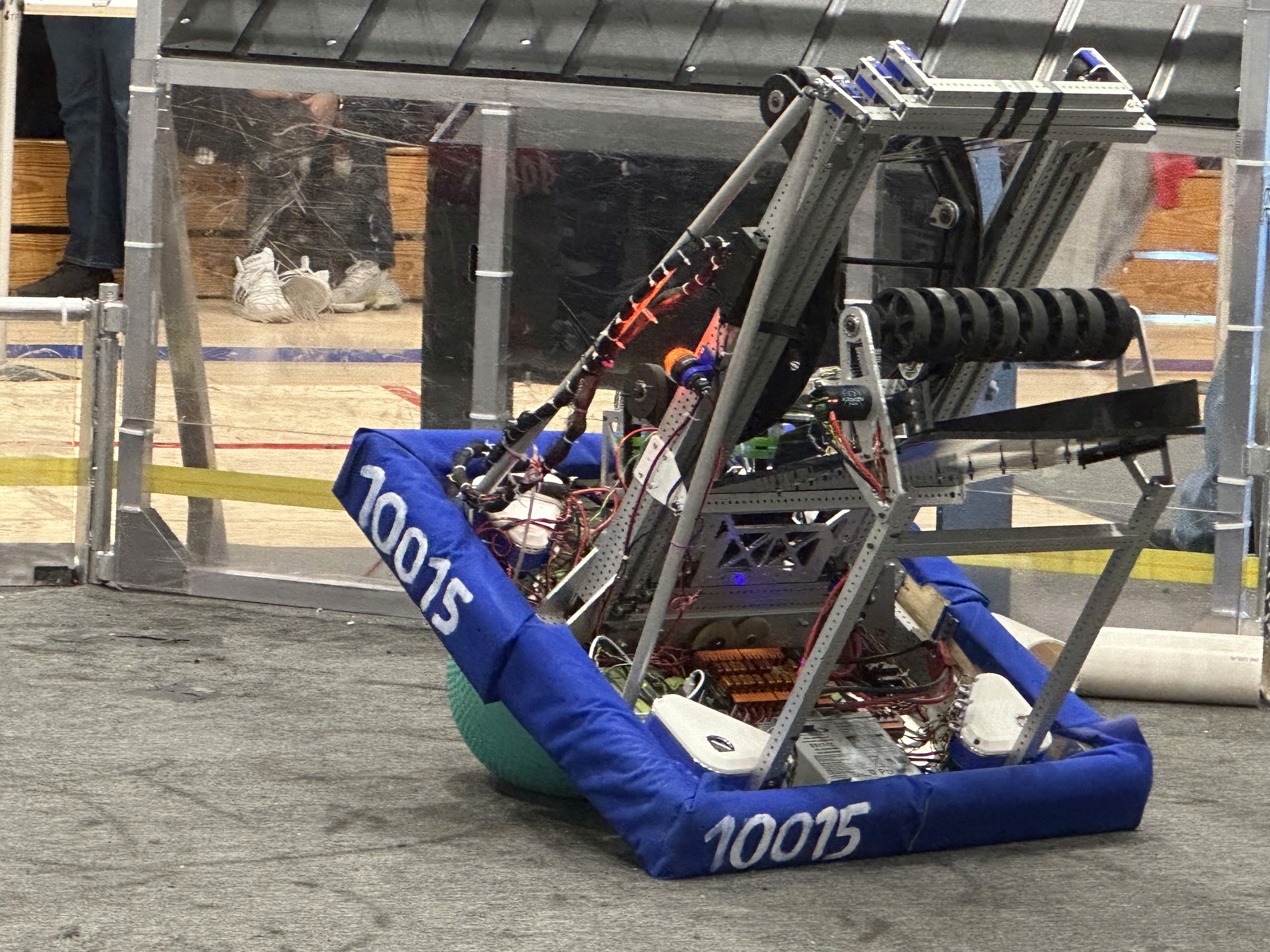
After winning Rookie All-Star at the FIRST Championship, FRC Team 10015 Bubbles used its first offseason competition to test a new roller robot design, learn from challenges, and improve through FRC community support (FRC Event).
By SolversMind Robotics
Published September 20, 2025 | Updated August 2, 2026
Reviewed by SolversMind Robotics mentors
A robot does not always teach a team through victories.
Sometimes, the most valuable lessons come from the moments when expectations are not met.
After an incredible rookie season, where FRC Team 10015 Bubbles earned the Rookie All-Star Award at the FIRST Championship in Houston with our innovative OctoMaster robot featuring the 3D-printed bio-inspired SpiRob octopus arm, the team entered its first offseason FRC competition at Mary Ward Catholic Secondary School with a new challenge.
A new robot.
A new mechanism.
A new level of expectation.
The team introduced its fourth-version offseason robot, featuring a roller-based intake system designed to improve efficiency and speed in the fast-paced environment of FRC competition.
The result was not what the team hoped for.
And yes, it was disappointing.
But the question we asked ourselves was:
“Is that a failure?”
The answer is no.
Because the purpose of an offseason competition is not only to win.
It is to learn.
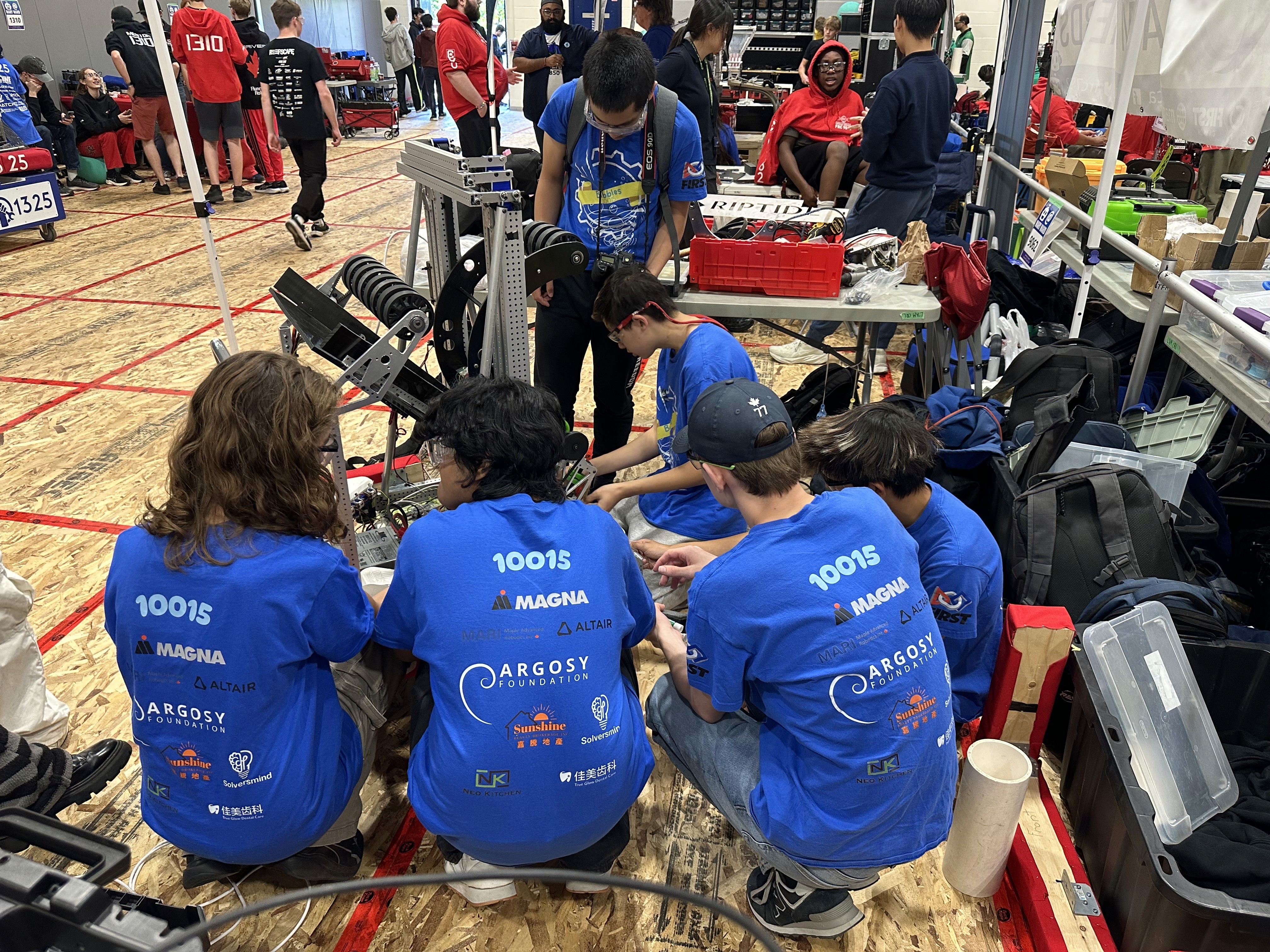
Why did Bubbles redesign its robot with a roller system?
After a successful rookie season, Bubbles began evaluating how to improve its robot design for future FRC challenges. The team recognized that while the OctoMaster’s SpiRob soft robotic arm was innovative and successful, a faster and more efficient roller-based mechanism could provide advantages in a high-speed FRC environment. After extensive discussions, brainstorming sessions, and engineering evaluation, the students decided to create their own version inspired by the successful design approach of FRC Team Dave. This offseason project became an opportunity for Bubbles students to expand their engineering skills, especially in advanced CAD modelling, mechanical integration, and rapid prototyping. The goal was not simply to copy a proven design, but to understand why the system worked and adapt those principles into a student-developed solution. The experience helped a young FRC team move from creating one successful robot to developing a stronger engineering process.
What did students learn from this offseason challenge?
The transition from the OctoMaster robot to the roller-based system represented an important step in Bubbles’ engineering growth.
During the rookie season, the team proved that young students could create something unique.
The SpiRob arm was a reflection of creativity, experimentation, and willingness to explore unconventional solutions.
However, FRC is also a competition where reliability, speed, consistency, and attention to detail matter.
The team realized that innovation is only one part of successful engineering.
A great mechanism must also work repeatedly under pressure.
The offseason project gave students the opportunity to explore a different engineering philosophy:
How can we make a system faster?
How can we simplify operation?
How can we improve reliability?
How can we design for real competition conditions?
Based on the team’s available resources and experience, students studied FRC Team Dave’s approach and developed their own version of a roller system.
This process became an excellent CAD learning opportunity.
Students had to think more carefully about:
Mechanical relationships
Part constraints
Manufacturing limitations
Assembly details
Serviceability
Mechanism interactions
For a young team, this was a significant step forward.
The students were no longer only designing individual mechanisms.
They were learning how complete systems are engineered.
Why was the competition result disappointing, and what did Bubbles learn?
Throughout the Mary Ward offseason competition, the team discovered several areas where its engineering process needed improvement.
The robot had functional capabilities, but performance was limited by details that the team had not fully anticipated.
Some challenges included:
Limited autonomous programming experience
Insufficient camera and computer vision integration
Accuracy issues during automated operations
Small design details that caused coral jams
The need for stronger testing procedures before competition
These issues may sound small.
In FRC, they are not.
A small alignment problem can become a missed scoring opportunity.
A minor mechanical interference can affect an entire match.
A few seconds lost during automation can change the outcome of a competition.
The entire team was excited to see what the new robot could achieve, so the results were naturally difficult to accept.
The students were disappointed.
And we do not want to hide that feeling.
It is important for students to experience the emotional side of engineering.
They invested time, energy, and creativity into the robot. They had high expectations.
When the performance did not match those expectations, it hurt.
But this is exactly where real engineering growth happens.
Failure is not the opposite of success.
It is part of the process that creates success.
The important question is not:
“Did we fail?”
The important question is:
“What did we learn?”
How did the FRC community help Bubbles improve?
One of the most meaningful parts of this experience was seeing the true spirit of the FRC community.
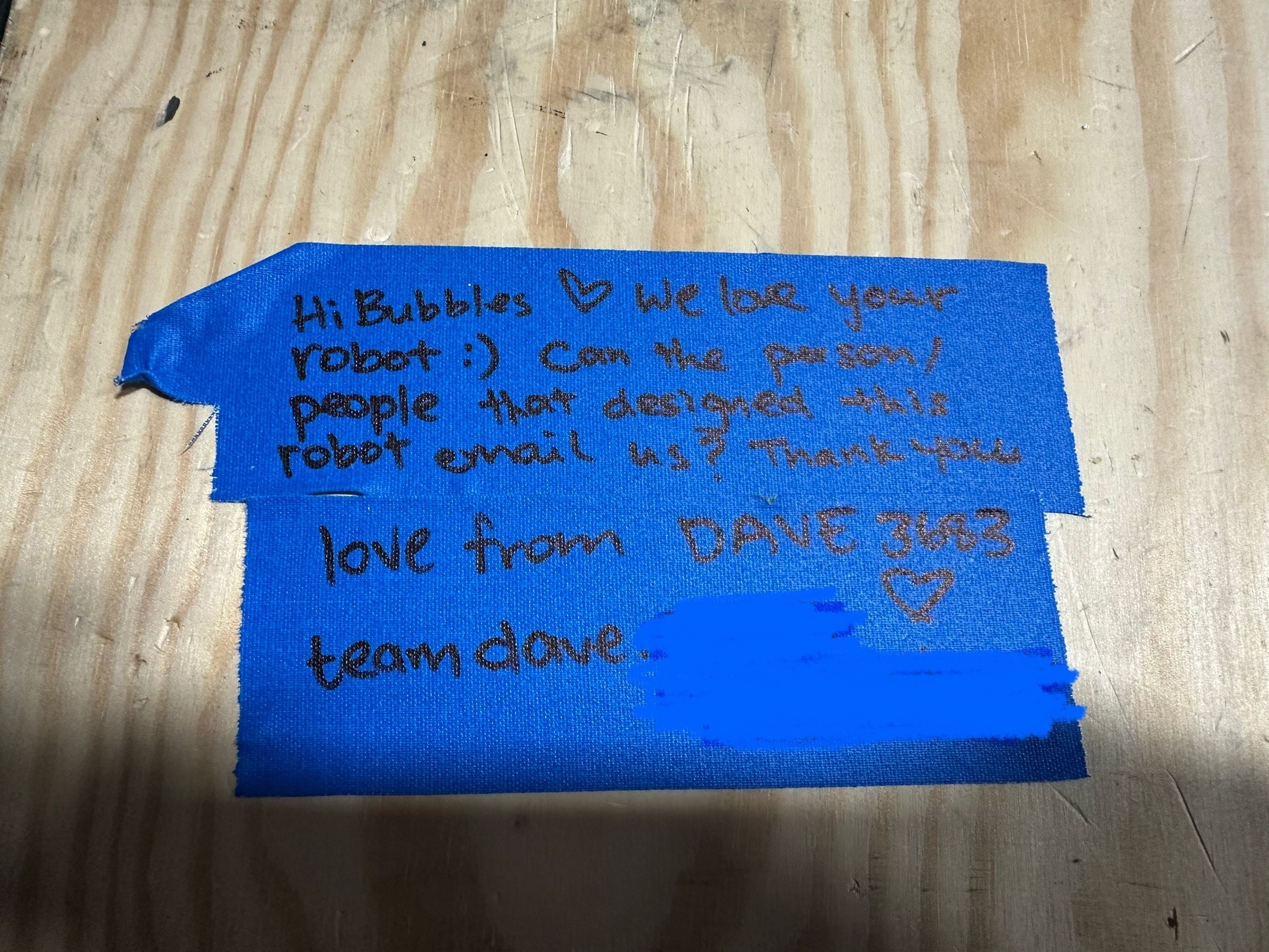
Instead of simply watching the results, Team Dave continued supporting Bubbles after the competition.
They took the time to discuss the robot design with our students and organized a Zoom meeting to provide feedback on improvement opportunities.
Their suggestions focused on details that could significantly improve performance without requiring a complete redesign.
The conversation helped students understand that strong engineering is often about refinement.
A successful robot is rarely created by one big idea.
It comes from hundreds of small improvements.
The Team Dave mentors helped Bubbles identify areas where mechanical details, programming strategy, and operational consistency could be improved.
This mentorship was extremely valuable for our students.
It showed them that FRC is not only about competing against other teams.
It is about learning together.
This is one of the reasons Bubbles hopes to continue contributing back to the FIRST community as we grow.
The same support that helped us during our early journey is the support we hope to provide to other teams in the future.
What comes next for Bubbles?
The Mary Ward competition was not the end of the story.
It was another chapter.
The team has already applied the lessons learned from the event and improved the robot design.
The roller system has been refined.
The mechanical details have been adjusted.
The students have gained a better understanding of autonomous programming, computer vision, testing, and competition preparation.
The improved robot will return for the upcoming STEMley Cup Overtime competition, where Bubbles hopes to demonstrate the progress made from this experience.
More importantly, the students will enter the next competition with a stronger mindset.
They now understand that engineering is not about creating a perfect robot on the first attempt.
It is about building, testing, failing, learning, and improving.
The OctoMaster robot helped Bubbles prove that a rookie team could innovate.
The roller robot is helping Bubbles learn how to refine.
Both experiences are valuable.
So, was Mary Ward a failure?
No.
It was a lesson.
A lesson about engineering.
A lesson about humility.
A lesson about the importance of community.
And a lesson that every great robotics team eventually learns:
The best teams are not the ones that never fail. The best teams are the ones that learn the fastest.
Tags:
FRC Team 10015 Bubbles, SolversMind Robotics, Mary Ward FRC, Team Dave, Aurora Robotics, FRC mentorship