From FLL Champions to Canada Cup Volunteers: Five SolversMind Students Begin Their FTC Journey
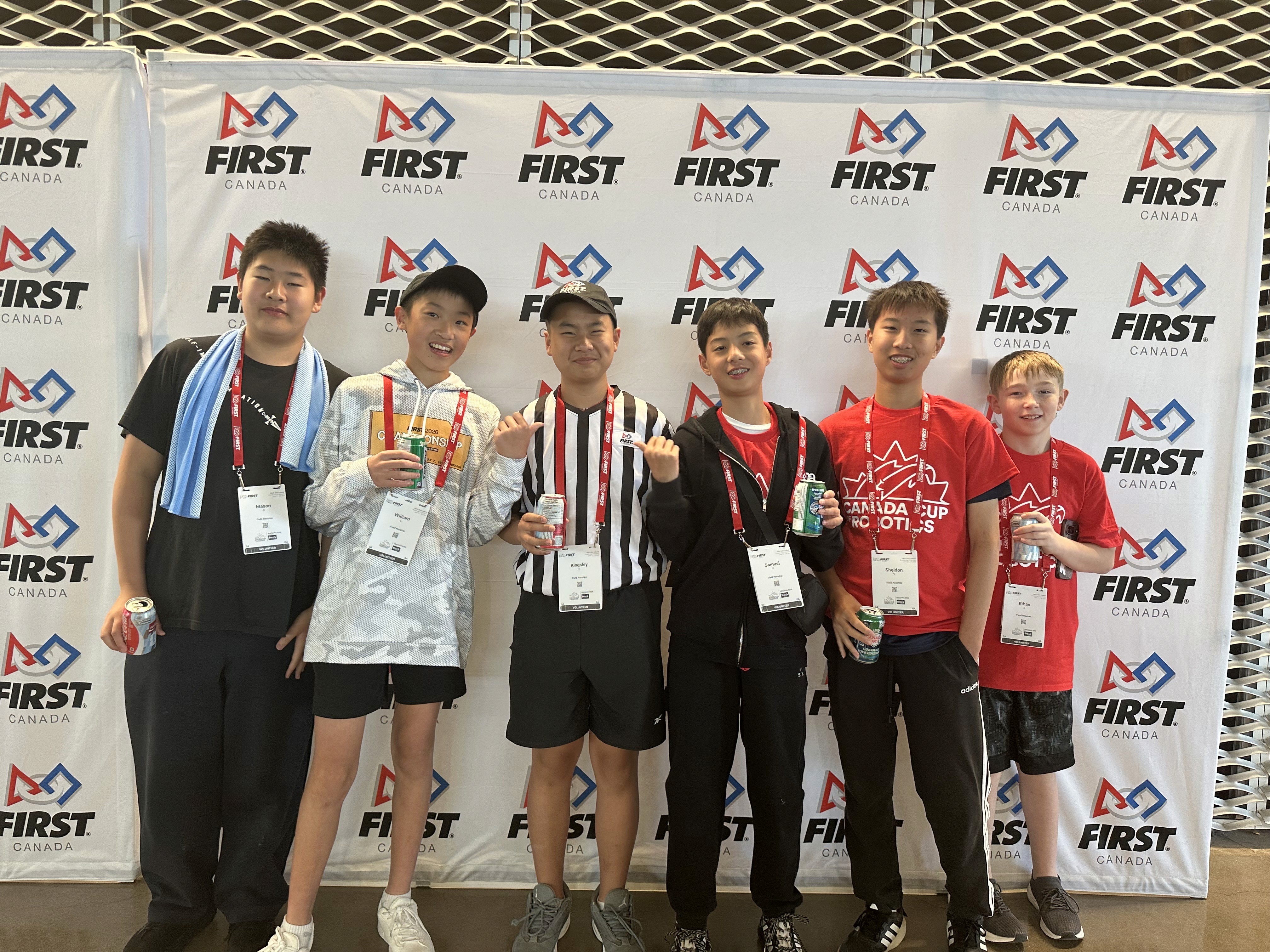
Five former Solvers of X & Y students volunteered as FLL field resetters at the Canada Cup of Robotics before beginning their rookie FTC journey with Team 35858 Bubblebotics (Brock University).
By SolversMind Robotics
Published June 20, 2026 | Updated July 29, 2026
Reviewed by SolversMind Robotics mentors
A robotics journey should not end when the competition season is over.
For five longtime members of FLL Team 52777 Solvers of X & Y, the Canada Cup of Robotics became an opportunity to step into a new role. Instead of arriving as competitors, they returned to the FIRST community as volunteers.
Kingsley Chen, William Li, Samuel Pan, Mason Ding, and Sheldon Ye served as field resetters during the FIRST LEGO League competition at the Canada Cup of Robotics – Niagara 2026.
Their contribution was an important outreach milestone for SolversMind Robotics and an early outreach activity for their new team, FTC 35858 Bubblebotics, which will begin its rookie FIRST Tech Challenge season in September 2026.
How did SolversMind students volunteer at the Canada Cup?
Five SolversMind students, Kingsley Chen, William Li, Samuel Pan, Mason Ding, and Sheldon Ye, volunteered at the FIRST LEGO League Canada Cup in Niagara as field resetters. Their job was to restore the competition tables accurately and efficiently after each match so the next team could compete under the same field conditions. Kingsley also took on referee responsibilities during the event, drawing on his previous FLL experience and detailed understanding of the robot game rules. The students were transitioning from FLL Team 52777 Solvers of X & Y into their new team, FTC 35858 Bubblebotics, making the event an important first outreach activity for their upcoming rookie FTC season. By supporting teams from around the world, communicating with referees and event staff, and demonstrating FIRST Core Values, the students showed that their FLL education had prepared them not only to build robots, but also to serve the wider robotics community.

Why was volunteering at the Canada Cup significant?
The Canada Cup of Robotics – Niagara 2026 was a large international FIRST event hosted at Brock University and the adjacent Canada Games Park.
The full event ran from June 14 to 20, with the FIRST LEGO League competition taking place from June 17 to 20. Brock University reported that the championship brought together more than 5,000 students, mentors, families, and spectators from more than 30 countries (Canada Cup of Robotics 2026).
For our students, volunteering at an event of this scale was a major responsibility.
Field resetters work behind the scenes, but their role is essential. After every match, they must return mission models, equipment, and field elements to the correct starting positions. They need to work quickly without sacrificing accuracy, because even a small mistake can affect the next team’s match.
This requires concentration, teamwork, patience, and a clear understanding of the game.
The students also interacted with competitors from different countries, cultures, and language backgrounds. Even when teams did not share the same first language, they shared the common language of FIRST: teamwork, fairness, respect, Gracious Professionalism, and Coopertition.
That made the experience much more than a volunteer shift.
It became an opportunity to practise leadership in a truly international environment.
How did Kingsley Chen become a referee?
Kingsley began the event as part of the volunteer team and was later given the opportunity to support the event as a referee.
That role required more than simply remembering the rules.
A referee must observe matches carefully, make fair decisions, explain rulings clearly, and communicate respectfully with teams, coaches, and other officials. Referees also need to remain calm when teams are excited, nervous, or disappointed.
Kingsley’s years of FLL experience helped prepare him for that responsibility.
As a former competitor, he understood how much every match meant to the students standing at the table. He also understood the robot game rules from the perspective of a builder, programmer, strategist, and driver.
That combination of technical knowledge and empathy allowed him to communicate with teams in a way that was both professional and supportive.
Brock University also featured a photo of Kingsley during its Canada Cup coverage, capturing him in his volunteer role and reflecting the Gracious Professionalism he demonstrated throughout the event.
For SolversMind, this recognition was especially meaningful. It showed how a student can grow from learning the rules, to competing under them, to helping uphold them for others.
What skills did the students gain from volunteering?
Volunteering gave the students a different understanding of how a major robotics event operates.
As competitors, students naturally focus on their own robot, project, judging sessions, and match schedule. As volunteers, they begin to see the larger system that makes the competition possible.
They learn that every successful event depends on hundreds of people working together.
The five students had to arrive prepared, follow event procedures, communicate with adult volunteers, listen carefully to instructions, solve small problems quickly, and maintain a professional attitude throughout long competition days.
They also strengthened several skills that will be important in FTC and in their future careers:
Clear communication
Time management
Attention to detail
Team coordination
Conflict-free problem solving
Professional conduct
Confidence when speaking with unfamiliar people
Responsibility in a high-pressure environment
These are not separate from STEM education.
They are part of becoming an engineer, researcher, entrepreneur, team leader, or working professional.
Technical knowledge may help a student build a robot, but communication and professionalism help that student work successfully with other people.
How did years of FLL prepare them for this role?
Kingsley, William, Samuel, Mason, and Sheldon spent several years growing through the FIRST LEGO League program.
As members of Solvers of X & Y, they learned how to design and program robots, study game rules, develop strategies, present innovation projects, answer judges’ questions, and work through setbacks as a team.
They also learned that FIRST is not only about winning matches.
Core Values taught them how to compete fairly, respect other teams, share knowledge, remain positive under pressure, and help others succeed.
Those lessons became visible at the Canada Cup.
The students understood why the fields needed to be reset precisely. They knew how stressful competition could feel for younger teams. They recognized when a student needed a clear explanation, a patient response, or simply a few encouraging words.
Their experience helped them serve not only as event volunteers, but also as informal role models for younger competitors.
This is one of the most valuable outcomes of a long-term robotics education.
Students begin as learners. Over time, they become experienced competitors. Eventually, they become the people who guide and support the next group.
Why is this considered an FTC Bubblebotics outreach event?
In September 2026, these five students will begin a new chapter as members of FTC Team 35858 Bubblebotics.
Their Canada Cup service marks one of the team’s earliest outreach activities.
FTC outreach is not limited to promoting a team or demonstrating a robot. It also includes contributing meaningfully to the FIRST community, supporting events, mentoring younger students, sharing experience, and helping create opportunities for others.
By volunteering before their rookie FTC season officially began, the students established an important part of Bubblebotics’ team identity.
They showed that the new team would not focus only on designing a competitive robot. It would also value service, leadership, professionalism, and community involvement.
The experience also gave them a closer look at how FIRST events are organized and how volunteers, referees, judges, field staff, and coordinators work together.
That understanding will help them become better FTC competitors.
When they enter their own matches, speak with referees, attend judging sessions, or host outreach activities, they will have a stronger appreciation for the people working behind the scenes.
What does holistic STEM education mean at SolversMind?
At SolversMind Robotics, our goal is not only to nurture students who can code, design, manufacture, and build robots.
We want to help them become thoughtful, capable, and professional young people.
That means giving students opportunities to take responsibility, communicate with adults, support younger participants, work with people from different backgrounds, and represent their team in public settings.
Robotics provides an excellent environment for this kind of development because it brings technical learning and human interaction together.
A student may begin by learning how to program a motor. Later, that student may lead a design meeting, explain an engineering decision to a judge, mentor a younger team, speak at a public event, or serve as a referee at an international competition.
Each experience builds a different part of the student.
This is what holistic education means to us.
We develop technical ability, but we also develop confidence, judgement, empathy, communication, leadership, and professional habits.
These skills will remain valuable long after a particular robot or competition season is over.
How does this event connect FLL, FTC, and future leadership?
The Canada Cup volunteer experience came at an important transition point for the students.
They were finishing one chapter as members of Solvers of X & Y and preparing to begin another with FTC 35858 Bubblebotics.
FLL gave them their technical and teamwork foundation.
Volunteering allowed them to apply that experience in service to others.
FTC will now challenge them to work with larger robots, more advanced systems, new engineering tools, and a higher level of team organization.
Their experience as Canada Cup volunteers will continue to influence how they approach that challenge.
They already understand that a successful FIRST team should contribute to the community around it. They have seen the importance of volunteers and officials. They have communicated with teams from around the world. They have represented SolversMind without needing to be the centre of attention.
These are signs of maturity.
They are also signs that the students are ready for the next level.
A new chapter for Bubblebotics
For Kingsley, William, Samuel, Mason, and Sheldon, the Canada Cup was not their final FLL memory.
It became the bridge between their FLL experience and their FTC future.
They arrived with years of competition knowledge and left with new experience in service, event operations, communication, refereeing, and international teamwork.
Most importantly, they showed that leadership does not always mean standing on the competition field with a robot.
Sometimes leadership means resetting the field for the next team.
Sometimes it means explaining a rule calmly.
Sometimes it means helping an event run smoothly without expecting recognition.
And sometimes it means using everything you have learned to create a better experience for someone else.
We are proud of these five students for representing SolversMind Robotics with maturity, professionalism, and care.
As they begin their rookie season with FTC 35858 Bubblebotics, they are carrying forward not only the technical experience of Solvers of X & Y, but also the values that made that journey meaningful.
Congratulations to Kingsley Chen, William Li, Samuel Pan, Mason Ding, and Sheldon Ye. Your FTC journey has already begun, not with a robot, but with service.
Tags:
Canada Cup of Robotics, FTC 35858 Bubblebotics, SolversMind Robotics, Solvers of X and Y, FIRST LEGO League, FIRST Tech Challenge, Kingsley Chen, William Li, Samuel Pan, Mason Ding, Sheldon Ye, Brock University, Aurora robotics