Twice in a Row: SolversMind’s FRC and FLL Teams on the World Stage

By SolversMind Robotics
Published May 2, 2026 | Updated July 29, 2026
Reviewed by mentors of FRC Team 10015 Bubbles
Wow! Once again, SolversMind made Canadian FIRST history as the only community-based organization in Canada to bring teams from two FIRST programs to the World Championship in the same season, both developed under the guidance of the same coach, Dahai Zhang.
Why is SolversMind’s back-to-back World Championship appearance important?
For the second consecutive year, SolversMind Robotics sent both a FIRST Robotics Competition team and a FIRST LEGO League team to the FIRST World Championship in Houston (NewmarketToday). FRC Team 10015 Bubbles competed in the Archimedes Division (FRC-Event), while FLL Team 52777 Solvers of X & Y earned the Robot Design Finalist Award (FIRSTInspires). Team captain Ryan Zhang was also recognized as a Global FRC Leadership Award Finalist (FRC-Event). Together, these achievements show the strength of SolversMind’s K-12 robotics pathway, where students can begin by building, coding, researching, and presenting in FLL, then continue into advanced engineering, manufacturing, programming, and leadership through FTC and FRC. More than a competition result, this back-to-back world-stage appearance reflects years of student growth, mentorship, teamwork, and community support. It also shows what young people from Aurora can accomplish when they are given the opportunity to solve real problems, lead their peers, and represent Canada with confidence.
What did Bubbles achieve at the 2026 FIRST Championship?
FRC Team 10015 Bubbles competed in the Archimedes Division, one of eight FRC divisions at the FIRST Championship.
Reaching Houston for the second time was another important milestone for this young community-based team. Bubbles began competing in FRC in 2025 and qualified for the World Championship during both of its first two seasons.
At the Championship ceremony, team captain Ryan Zhang was recognized as a Global FRC Leadership Award Finalist. The recognition celebrated his technical contributions, student leadership, mentorship, community outreach, and commitment to the culture and values of FIRST.
For our students, competing on the Archimedes field was about much more than match results. It was an opportunity to test their robot against strong international teams, learn from different engineering approaches, and experience the excitement of the global FIRST community.
How did Solvers of X & Y earn international recognition?
At the same time, FLL Team 52777 Solvers of X & Y continued its incredible FIRST LEGO League journey.
After becoming the Ontario Champion for the second consecutive year, the team advanced to the FIRST LEGO League World Festival in Houston (FIRST Canada). There, Solvers of X & Y received the Robot Design Finalist Award, placing the team among the world’s strongest FLL teams in mechanical design, programming, strategy, testing, and engineering communication.
This was also the team’s second consecutive appearance on the world stage. In 2025, Solvers of X & Y was named an Innovation Project Award Finalist for its seaweed-based biodegradable plastic solution (FIRSTInspires).
Returning one year later and earning recognition in a different award category demonstrated the team’s continued growth across every part of FIRST LEGO League.
What did our students experience beyond the competition?
It was an unforgettable journey.
During the competition and beyond the matches, our students met teams from around the world, exchanged ideas, learned from other young engineers, and built new friendships. They experienced the spirit of Gracious Professionalism, where teams compete at the highest level while continuing to support and learn from one another.
There were exciting matches, challenging moments, new discoveries, and countless memories.
Most importantly, our students had fun. They represented Aurora and Canada with confidence, kindness, teamwork, and pride.
Why has SolversMind’s training model been so successful?
Bringing both FRC Team 10015 Bubbles and FLL Team 52777 Solvers of X & Y to the FIRST World Championship for two consecutive years was not the result of one competition, one robot, or one group of unusually talented students.
It was the result of a long-term training model built around one principle:
Put students first.
At SolversMind, the goal is not to use coach-completed work as a shortcut to winning awards. The goal is to train students seriously, teach them difficult concepts clearly, and prepare them to complete meaningful work independently.
Coaches provide instruction, structure, safety supervision, technical guidance, and continuous feedback. Students are expected to research, design, build, program, test, troubleshoot, document, present, and improve their own work.
This approach takes more time than simply giving students an answer or completing a difficult task for them. However, it develops something far more valuable: students who genuinely understand what they are doing and can apply that knowledge independently.
The results are visible across SolversMind’s programs. In 2026, FRC Team 10015 Bubbles returned to the FIRST Championship during only its second FRC season, while Solvers of X & Y became Ontario Champion for the second consecutive year and earned the Robot Design Finalist Award at the FIRST LEGO League World Festival.
Training continues throughout the entire year
One of the most effective parts of the SolversMind model is year-round training.
The competition season is not the best time to introduce every complicated concept for the first time. During the season, students are already working under deadlines while designing robots, solving technical problems, preparing presentations, conducting research, and attending competitions.
SolversMind therefore uses the offseason to build the knowledge students will need later.
Students may study and practise:
Mechanical design and engineering fundamentals
CAD and technical drawing
Programming and control systems
Robot mechanisms and manufacturing
Sensors, electronics, and data analysis
Research and problem definition
Technical documentation
Public speaking and judging presentations
Teamwork, leadership, and project management
By the time the competition season begins, students are prepared to apply those skills to real challenges.
The offseason is for learning, experimenting, and building foundations.
The competition season is where students take ownership, make decisions, solve unexpected problems, and put their knowledge into action.
This model allows coaches to teach intensively without taking the work away from students. The students enter the season with stronger foundations, so they can take on more difficult hands-on responsibilities themselves.
First-principles thinking makes difficult ideas easier to understand
Dahai Zhang promotes first-principles thinking throughout his teaching.
Rather than asking students to memorize a solution or copy something that has worked before, he asks them to break a problem into its most basic parts:
What are we trying to achieve?
What do we know to be true?
What forces, constraints, or rules are involved?
Why does the current design work or fail?
Which assumptions are we making?
Can the problem be solved in a simpler way?
What evidence supports our decision?
This approach helps students understand the logic behind an idea instead of memorizing isolated instructions.
A complicated robot mechanism becomes easier to understand when students examine the forces, motion, geometry, materials, and constraints separately.
A programming problem becomes clearer when students identify the inputs, outputs, conditions, feedback, and expected behaviour.
An Innovation Project becomes more meaningful when students first define the real problem, the people affected, the limitations of current solutions, and the evidence needed to support a new idea.
First-principles thinking also strengthens critical thinking. Students learn not to accept the first answer automatically. They learn to question assumptions, compare alternatives, test ideas, use evidence, and explain why one solution may be stronger than another.
This makes complicated concepts more logical, connected, and manageable.
Students must be able to teach what they have learned
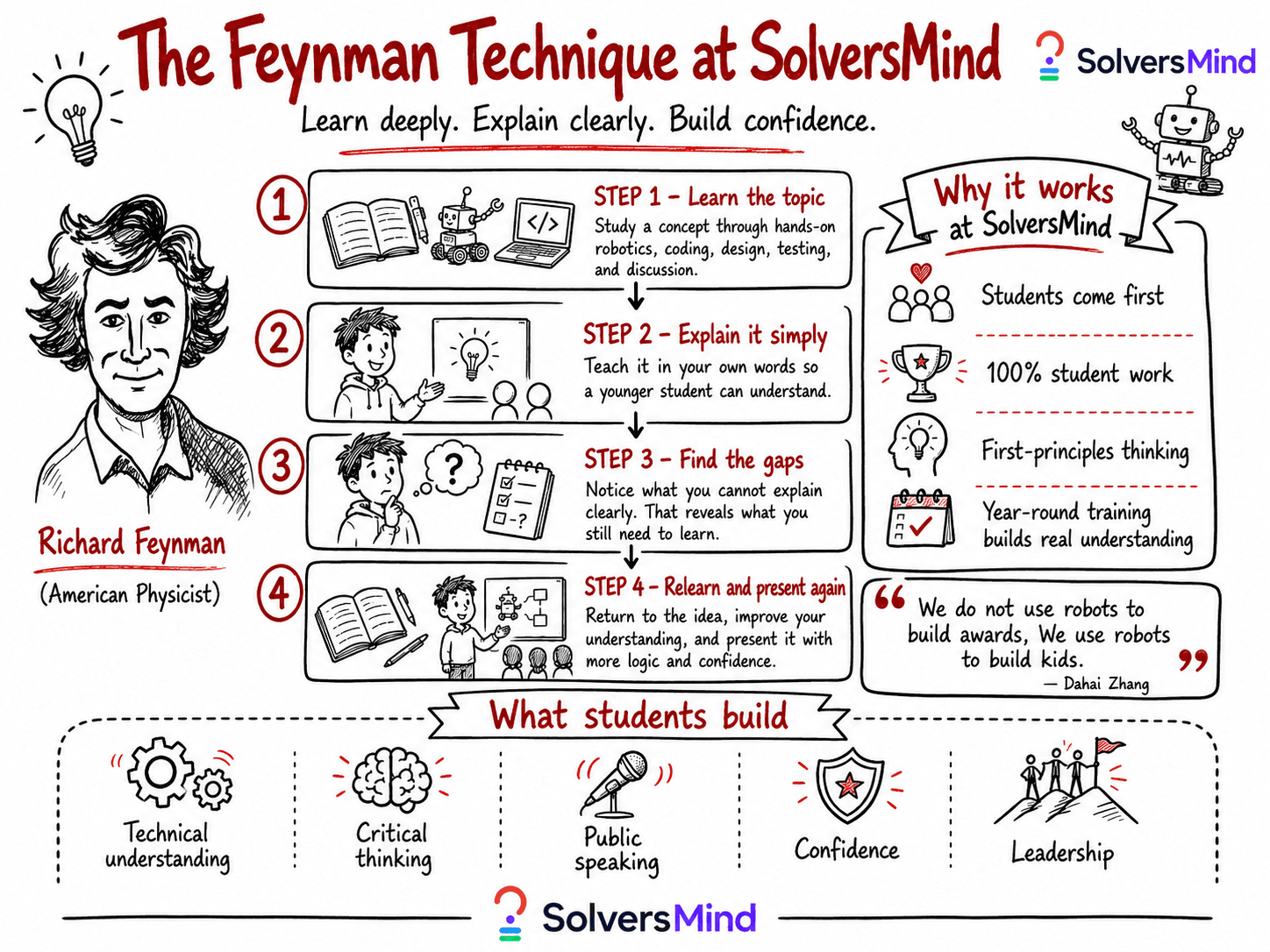
Dahai Zhang then uses a teaching approach commonly known as the Feynman Technique.
The principle is simple: students do not fully understand a concept until they can explain it clearly in their own words.
At SolversMind, students are regularly asked to prepare and deliver presentations about different parts of their work. Depending on the program and project, they may explain:
How a robot mechanism works
Why a particular design was selected
How a program controls the robot
What caused a technical failure
How testing changed the design
What data supports a conclusion
How the team divided responsibilities
What the Innovation Project is solving
What the students learned from the process
When students cannot explain an idea clearly, it often reveals that their understanding is incomplete.
The coach then returns to the concept, asks more questions, identifies the missing knowledge, and gives the student another opportunity to explain it. Students repeat this process until they can communicate the idea accurately, logically, and confidently.
Research on self-explanation supports this type of learning. Studies have found that prompting learners to explain ideas in their own words can improve understanding, retention, and the ability to transfer knowledge to new problems, especially when explanation is combined with strong instruction and guided practice.
Presentations are part of technical training
At SolversMind, presentations are not treated as an activity that begins shortly before judging.
They are part of the learning process throughout the year.
Students present to coaches, teammates, parents, teachers, judges, community members, sponsors, and younger students. Every presentation requires them to organize their thoughts, identify the most important information, answer questions, and communicate technical ideas in language another person can understand.
This repeated practice develops:
Deeper technical understanding
Logical thinking
Clear communication
Public speaking ability
Confidence under pressure
The ability to answer unexpected questions
Leadership and teamwork
Respect for different audiences and perspectives
These skills are essential in FIRST, where students must not only create a strong robot or project, but also explain their decisions, reflect on their learning, work effectively with others, and communicate their impact.
They are also essential far beyond robotics.
A student who can understand a difficult idea, apply it to a real problem, and explain it confidently has developed a skill set that will support future learning, university studies, careers, entrepreneurship, and community leadership.
Awards are the outcome, not the purpose
SolversMind teams have received significant recognition, including Ontario championships, international finalist awards, engineering and design awards, leadership distinctions, and repeated appearances at the FIRST World Championship.
But awards are not the starting point of the training model.
The starting point is student development.
The goal is to help students become capable of:
Thinking independently
Solving unfamiliar problems
Building and testing their own ideas
Learning from failure
Explaining complicated concepts
Communicating with confidence
Supporting their teammates
Taking responsibility for meaningful work
Leading others with knowledge and integrity
When students develop these abilities, strong competition results become a natural outcome of the learning process.
This is why SolversMind’s model works.
Students are trained throughout the year.
Difficult concepts are broken down through first-principles thinking.
Critical thinking is expected in every design and decision.
The Feynman Technique turns understanding into clear explanation.
Presentations strengthen knowledge, public speaking, and confidence.
Coaches teach and guide, but students complete the work.
We do not use students to build award-winning robots. We use robotics to build capable, confident, and thoughtful young people. The awards show what those students can achieve.
How does this milestone reflect SolversMind’s K–12 STEM pathway?
Twice in a row, our FRC and FLL teams stood together at the FIRST World Championship.
This achievement demonstrates the strength of SolversMind’s K–12 robotics education pathway. Students can begin in FIRST LEGO League by learning coding, robot design, research, teamwork, and presentation skills. As they grow, they can continue into FTC and FRC, where they take on more advanced work in CAD, manufacturing, electronics, programming, project management, outreach, and leadership.
Many older students also return to mentor younger teams, sharing their experience and helping the next generation grow.
This moment was not simply the result of one competition or one season. It represented years of learning, persistence, mentorship, family support, and teamwork.
Congratulations to FRC Team 10015 Bubbles and FLL Team 52777 Solvers of X & Y.
What a journey. What a memory. What a proud moment for our community!
We believe these young innovators will shine even brighter in the next chapter of their FTC and FRC journeys.
Tags:
FIRST World Championship 2026, FRC Team 10015, FLL Team 52777, FIRST Robotics Competition, FIRST LEGO League, Canada robotics, Ontario robotics, STEM education, Houston, Aurora, Ryan Zhang, Dahai Zhang, Solvers of X & Y, Bubbles, Renee Zhang, First Principles Thinking, Critical Thinking, Feynman Technique