A Legacy Reignited: Solvers of X & Y Wins Ontario Champion’s Award and Advances to the World Festival
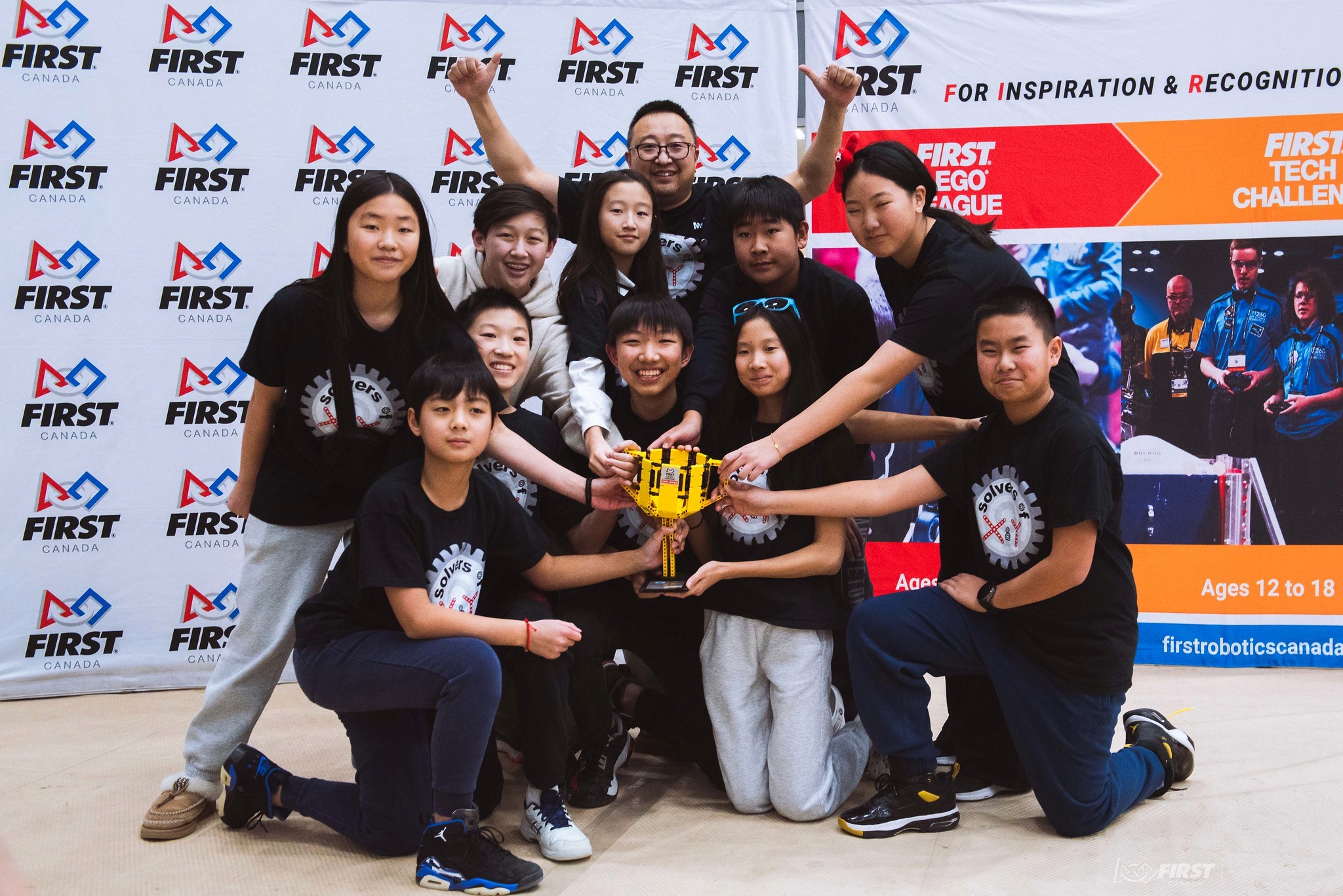
FLL Team 52777 Solvers of X & Y earned the Champion’s Award, 1st Place, at the 2025 FIRST LEGO League Ontario Provincial Championship (Technology Division) and qualified to represent Canada at the FIRST World Festival in Houston. The emotional victory carried forward a SolversMind legacy built through years of student ownership, patient growth, youth mentorship, first-principles thinking, and a seaweed-based bioplastic project addressing ocean pollution at its source (FIRST Canada).
By SolversMind Robotics
Published January 19, 2025 | Updated July 23, 2026
Reviewed by SolversMind Robotics mentors
How did Solvers of X & Y become the 2025 Ontario FLL Champion?
FLL Team 52777 Solvers of X & Y earned the Champion’s Award, 1st Place, at the 2025 FIRST LEGO League Ontario Provincial Championship, securing the honour of representing Canada at the FIRST World Festival in Houston. The result placed the Aurora team at the top of a provincial program involving hundreds of teams and young innovators across Ontario. The students also earned the Robot Performance Award, 2nd Place, while their seaweed-based biodegradable plastic project was featured on the centre stage during the championship awards ceremony. The victory was one of the most emotional and important moments in SolversMind history. It represented years of patient development, student-owned work, mentorship between generations, and lessons carried forward from the original Solvers of X & Y team. More than a provincial title, the award proved that a new generation could inherit a legacy without simply repeating it, then transform that foundation into its own world-level achievement.
When the team name was announced, the excitement was overwhelming.
Students shouted.
Families cried.
Mentors looked at one another in disbelief.
For years, SolversMind teams had worked toward this moment. They had produced strong robots, ambitious Innovation Projects, regional victories, provincial awards, and countless lessons that could never be summarized by a trophy.
Now, finally, the words were real:
Champion’s Award, 1st Place (FLLtournament).
Ontario Champion.
Advancing to the FIRST World Festival.
It was not only the victory of one team on one day.
It was the release of years of accumulated experience, patience, disappointment, mentorship, and belief.
How did the new generation carry forward the Solvers of X & Y legacy?
The name Solvers of X & Y already carried a long history inside SolversMind.
The earlier generation, led by Ryan Zhang and a talented group of young Solvers, competed together across four seasons. They consistently produced excellent results through robot performance, engineering design, Innovation Projects, research, presentations, and teamwork.
They came close to the international stage, but never received the opportunity to attend the FIRST World Festival.
That did not make their journey unsuccessful.
Their work created the foundation upon which the next generation could stand.
They developed technical knowledge.
They established team systems.
They learned how provincial-level judging worked.
They discovered which training methods produced genuine student ownership.
They created a culture in which older students did not leave with their knowledge. They passed it down.
At SolversMind, we learned to be patient.
Not every strong team reaches the World Festival immediately. Not every season ends with the result students hoped for. Progress in FIRST is rarely a straight line.
Experience accumulates.
Knowledge transfers.
Confidence grows.
One generation creates opportunities that the next generation may finally be ready to capture.
When the original Solvers of X & Y students moved forward into their FRC journey and helped establish FRC Team 10015 Bubbles, a new group inherited more than a team name.
They inherited a spirit.
They inherited the belief that students should understand and own their work.
They inherited the habit of questioning assumptions, testing repeatedly, communicating confidently, and refusing to stop when the first solution failed.
The new team had already developed three years of its own FLL experience. It was not simply following instructions left by older students. Its members combined inherited knowledge with their own research, decisions, failures, friendships, and technical growth.
The Ontario championship therefore represented both continuity and renewal.
“This win is more than a trophy—it’s a passing of the torch,” said head coach Mr. Dahai Zhang, who has guided both generations. “Our alumni now run an FRC team, and their younger peers just earned a place on the world stage. This is exactly what FIRST is all about.”
The former team had built the path.
The new generation carried the legacy farther than it had ever gone before.
Why did the Champion’s Award mean more than winning a robot competition?
The FIRST LEGO League Champion’s Award recognizes complete team excellence.
Robot performance matters, but it is only one part of the result. Teams must also demonstrate strong Robot Design, an innovative and well-researched project, effective teamwork, communication, and the FIRST Core Values.
Solvers of X & Y earned the award because the students brought those elements together into one complete performance.
Their robot records a top score of 415 in the Technology Division, the 3rd highest score (FLLtournament).
Their Innovation Project addressed plastic pollution through a student-developed seaweed-based biodegradable material.
Their presentations demonstrated research, testing, critical thinking, and confidence.
Their teamwork reflected years of shared experience and mentorship.
Most importantly, the students could explain their work because the work genuinely belonged to them.
Judges were not seeing young people standing beside solutions created by adults.
They were seeing students who understood the decisions, evidence, limitations, failures, and improvements behind every part of their season.
That distinction is central to the SolversMind model.
The goal is not to produce the most polished object adults can build for students.
The goal is to create an environment in which students gradually become capable of producing work that once seemed beyond their age.
The provincial championship gave those students a visible result, but the deeper achievement had already happened.
They had become researchers.
They had become designers.
They had become programmers.
They had become speakers, teammates, mentors, and problem-solvers.
The trophy recognized the team they had built.
Their growth revealed the young people the process had built.
How did the seaweed-bioplastic project use first-principles thinking?
The team’s Innovation Project began with ocean plastic pollution, but the students did not stop at the familiar message of cleaning beaches or placing more materials into recycling bins.
Solvers of X & Y were invited to the center stage to present their innovation project to the whole audience before the award ceremony. This is a highlighted moment for our team to showcase what our student work can do.
They asked a deeper question:
Why does the pollution exist in the first place?
Traditional plastic is useful because it is lightweight, inexpensive, durable, and adaptable. However, those same qualities become environmental problems when products designed for minutes of use remain in ecosystems for decades or longer.
The students used first-principles thinking to break the challenge into fundamental questions:
Which properties of plastic are truly necessary?
Why do conventional plastics remain in the environment for so long?
Which disposable products are difficult to recycle effectively?
Could a renewable biological material provide similar functions?
Could that resource grow without competing for farmland?
Could the material return to the environment more safely after use?
Could pollution be prevented through design instead of managed only after disposal?
This reasoning led them to seaweed.
Seaweed grows rapidly, does not require farmland, and can be cultivated without the freshwater demands associated with many land crops. The students explored whether it could become the foundation of a biodegradable material suitable for packaging and other short-life applications.
Their work connected the different parts of a broader 6R sustainability framework.
The exact wording of the 6Rs can vary between educational models, but the central ideas include refusing unnecessary consumption, reducing material use, reusing products, repairing or repurposing items, recycling resources, and redesigning systems to prevent waste.
The team recognized that these actions are not separate puzzle pieces.
They must work together.
Reduce the amount of disposable material entering the system.
Reuse products whenever practical.
Recycle materials when effective processing is available.
Rethink and redesign products whose environmental cost is built into the material from the beginning.
Recycling remains important, but it cannot solve every form of plastic pollution. Some items are contaminated, difficult to separate, uneconomical to process, or degraded after repeated recycling.
The students therefore moved their attention upstream.
Rather than asking only how society could manage more plastic waste, they asked how a different material could avoid creating the same persistent waste.
That was the innovation.
The project tackled ocean pollution closer to its source.
Its importance was recognized visibly at the Ontario Provincial Championship, where the students were invited to present their seaweed-based biodegradable plastic project on the centre stage during the awards ceremony for the assembled FLL community.
For the students, that invitation was already an extraordinary honour.
Before the Champion’s Award was announced, their ideas had been given a platform.
They were no longer only discussing environmental change inside a judging room.
They were sharing their work with an entire provincial community.
Why was this victory a defining moment in SolversMind history?
SolversMind had waited years for this moment.
The original team had shown what disciplined student work could produce, even without reaching the World Festival.
Its members later carried their experience into FRC Team 10015 Bubbles, beginning a new and much more technically demanding journey.
The younger Solvers of X & Y team inherited the lessons of that earlier group while building an identity of its own.
Then, at the 2025 Ontario Provincial Championship, those separate journeys connected.
The former FLL students were moving into FRC.
The new generation had become Ontario Champion.
The path now extended from younger students learning with LEGO robots to high school students developing full-size competition machines.
The legacy was no longer attached to one team roster.
It had become a sustainable educational system.
This is why we cannot thank the students and youth mentors enough.
Former team members shared technical knowledge, judging experience, presentation skills, strategy, encouragement, and the confidence that comes from having already survived difficult seasons.
The current students accepted that support, but they still had to perform the work themselves.
They had to design the robot.
They had to write the programs.
They had to research plastic pollution.
They had to formulate and test materials.
They had to answer the judges’ questions.
They had to remain composed when the championship result was uncertain.
Mentorship can open a door.
Students must still walk through it.
The victory demonstrated what can happen when knowledge is passed forward without taking ownership away from the next generation.
The older students did not build a provincial championship project for the younger team.
They helped create younger students who were capable of building one themselves.
That is the legacy.
What does this achievement reveal about the SolversMind training philosophy?
SolversMind believes students can do more when they are given strong foundations, meaningful goals, patient guidance, and genuine ownership.
We do not expect students to avoid failure.
We expect them to learn how to use failure.
We do not believe the mentor’s role is to provide every answer.
The mentor teaches technical principles, protects student safety, establishes high standards, asks difficult questions, and helps students find appropriate resources.
Students must still make decisions.
They must test their assumptions.
They must experience the consequences of their designs.
They must explain why they changed direction.
This approach can take longer than simply giving students a completed solution.
It is also why the results matter.
The provincial championship was not created during one successful judging session.
It was built through three years of experience for the current group and through the accumulated lessons of the SolversMind teams that came before them.
It was built in the evenings when students tested one more robot run.
It was built when a prototype failed and the team chose to begin again.
It was built when older students returned to teach younger ones.
It was built when students researched material science beyond what would normally be expected in their classrooms because they needed the knowledge to advance a project they cared about.
This is the power of motivation and student ownership.
When students own the goal, they begin learning with purpose.
They voluntarily push into advanced robotics, programming, research, environmental science, and engineering concepts because those ideas are no longer abstract lessons.
They are tools required to achieve a dream.
The 2025 Ontario Champion’s Award was a perfect demonstration of this philosophy.
The students did not simply receive a legacy.
They understood it, strengthened it, and carried it to the world stage.
What comes next for Solvers of X & Y and the original team?
By winning the Champion’s Award, Solvers of X & Y earned the honour of representing Canada at the FIRST World Festival in Houston.
The students would now prepare to stand among teams from around the world.
They would refine their robot, strengthen mission consistency, deepen their project evidence, practise responding to unfamiliar questions, and learn how to represent their team, Aurora, Ontario, and Canada with confidence.
The World Festival was not simply a reward for winning provincials.
It was a new responsibility.
At the same time, the former Solvers of X & Y students were beginning their own journey with FRC Team 10015 Bubbles.
We hoped they would carry the same spirit into FRC:
authentic student ownership
craftsmanship
technical curiosity
critical thinking
perseverance
mentorship
service to the wider FIRST community
The two generations were now moving forward on different stages of the same pathway.
One was preparing for its first FLL World Festival.
The other was building the foundation of a new FRC team.
Both carried the same belief:
Students can do meaningful work.
Students can build knowledge that lasts beyond one season.
Students can inherit a legacy and still create something entirely their own.
This victory belonged to the current Solvers of X & Y students.
It also honoured every student, parent, mentor, and former team member whose work helped make the moment possible.
After years of patience, the door to the world stage had finally opened.
The students were ready to walk through it.
A Season of Outstanding Results Across Two SolversMind FLL Teams
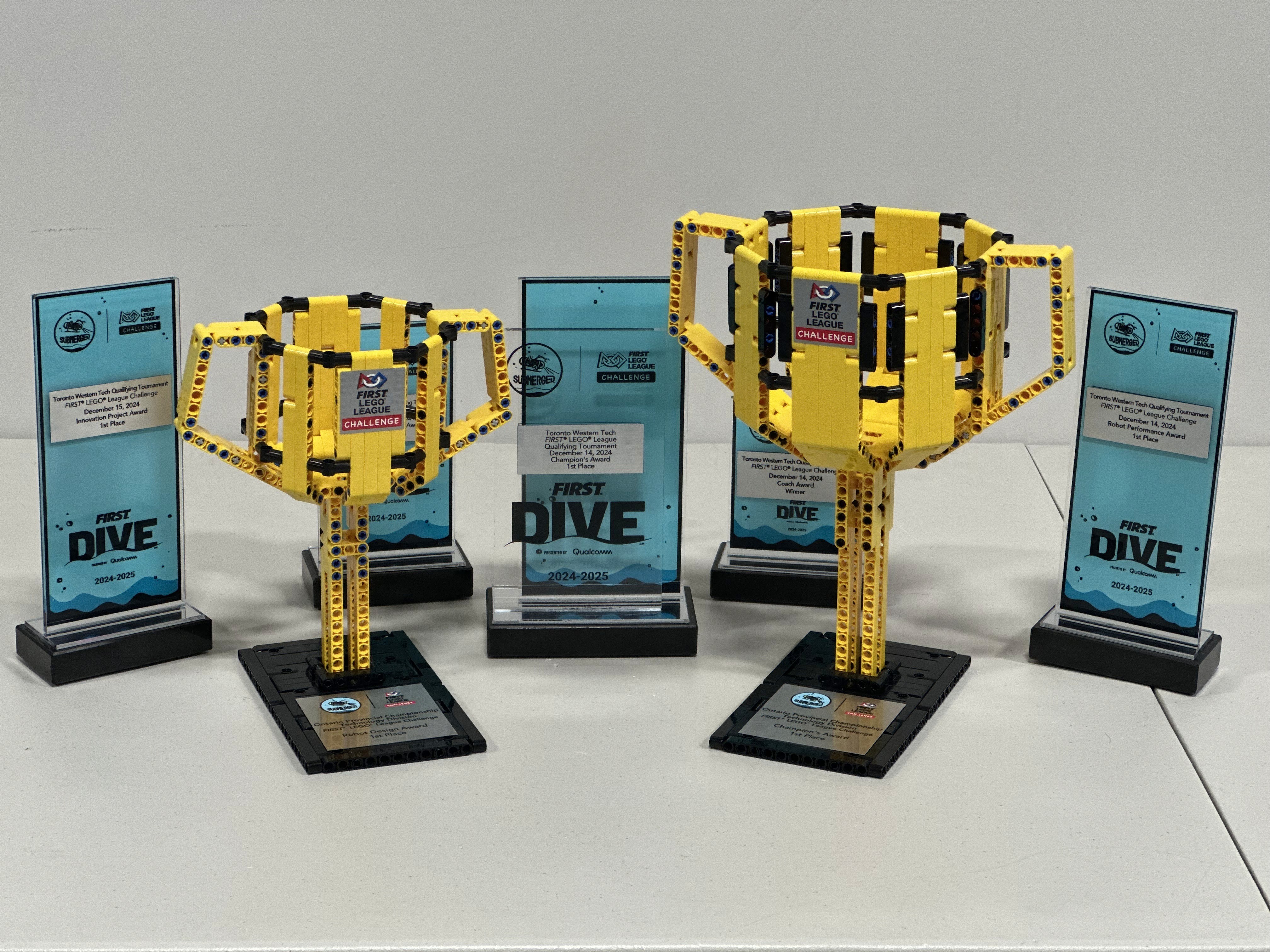
FLL Team 52777 Solvers of X & Y has already achieved an exceptional season, earning recognition across every major area of FIRST LEGO League:
Champion’s Award, 1st Place at the Ontario Provincial Championship
Advancement to the FIRST World Festival, representing Canada
Innovation Project Award at the Regional Qualifying Tournament
Robot Performance Award, 2nd Place at the Regional Qualifying Tournament
Their sister team, FLL Team 52736 Unknown Solvers, also completed a remarkable season marked by strong engineering, robot performance, teamwork, and coaching recognition:
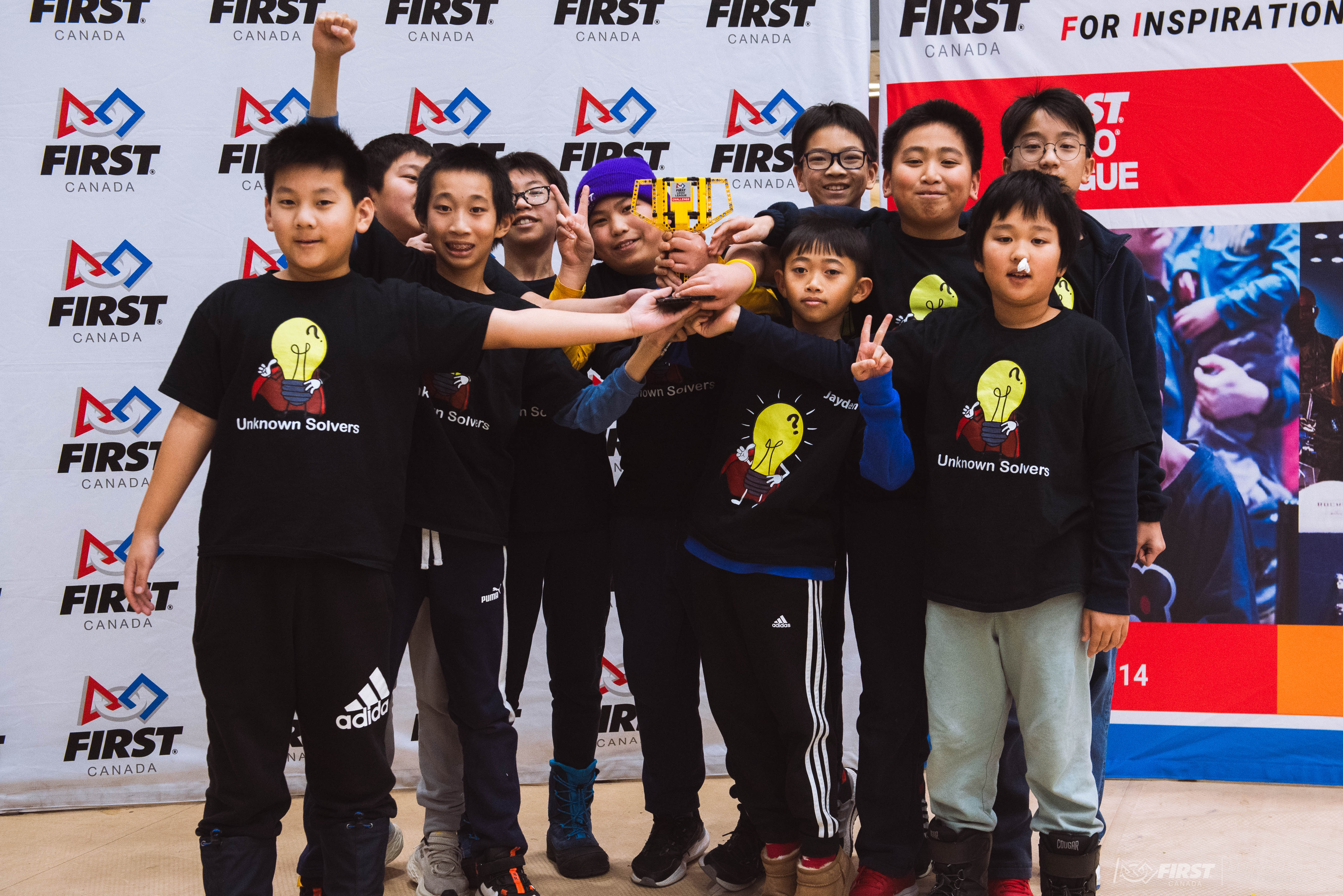
Robot Design Award, 1st Place at the Ontario Provincial Championship
Champion’s Award, 1st Place at the Regional Qualifying Tournament
Robot Performance Award, 1st Place at the Regional Qualifying Tournament
Coach Award (Ryan Zhang) at the Regional Qualifying Tournament
Together, the two teams demonstrated the depth and consistency of SolversMind’s FIRST LEGO League program. Their results were not limited to one category or one competition. They reflected excellence in robot design, robot performance, innovation, teamwork, leadership, and long-term student development.
Tags:
Solvers of X & Y, FLL Team 52777, Ontario Champion, Champion’s Award, FIRST World Festival, FIRST LEGO League, SUBMERGED, Seaweed Bioplastic, Biodegradable Plastic, Ocean Pollution, 6R Sustainability, First-Principles Thinking, Critical Thinking, Student Ownership, Ryan Zhang, Renee Zhang, FLL to FRC, SolversMind Robotics, Aurora Robotics, York Region Robotics