Youngest Team Demonstrates Exemplary FIRST Core Values

SolversMind’s youngest FIRST LEGO League Challenge team, Future Solvers, earned the Core Values Award 1st Place at the Scarborough David and Mary Thomson Qualifying Tournament on December 7, 2025, and advanced to the Ontario Provincial Championship (FIRST Canada).
By SolversMind Robotics
Published December 7, 2025 | Updated July 17, 2026
Award Recipient: Future Solvers
Reviewed by SolversMind FIRST LEGO League mentors
What did Future Solvers achieve?
Future Solvers, a team of eight-year-old students and the youngest FIRST LEGO League Challenge team at SolversMind Robotics, won the Core Values Award 1st Place at the Scarborough David and Mary Thomson Qualifying Tournament on December 7, 2025. The team also advanced to the Ontario Provincial Championship. Their robot and Innovation Project were still developing, but their teamwork, confidence, kindness, inclusion, courage, and positive attitude stood out throughout the competition. The students supported one another, shared responsibilities, communicated respectfully, and approached every challenge with joy. Their achievement demonstrates an essential lesson of FIRST LEGO League: success is not measured only by robot scores or technical complexity. It is also measured by how students learn together, solve problems, respond to setbacks, include every teammate, and treat other teams with respect. Future Solvers showed that even the youngest students can become confident collaborators, thoughtful problem-solvers, and inspiring representatives of the FIRST community.
Can a team of eight-year-olds succeed in FIRST LEGO League?
What can a group of eight-year-olds accomplish at a FIRST LEGO League competition?
They may not begin with the most advanced robot.
They may not have years of programming or engineering experience.
They may still be learning how to explain an Innovation Project, organize a presentation, divide team responsibilities, and perform under pressure.
But Future Solvers demonstrated something even more important: the spirit of FIRST.
Throughout the season, the students learned how to listen to one another, share ideas, encourage teammates, overcome disappointment, and celebrate progress. At the qualifying tournament, they brought those lessons onto the competition floor.
Their confidence, kindness, teamwork, courage, and joy inspired the people around them.
They did not simply participate in FIRST LEGO League.
They demonstrated what FIRST LEGO League is meant to be.
Why did Future Solvers win the Core Values Award?
The FIRST Core Values are:
FIRST Core Value | What it means |
|---|---|
Discovery | We explore new skills and ideas |
Innovation | We use creativity and persistence to solve problems |
Impact | We apply what we learn to improve our world |
Inclusion | We respect one another and embrace our differences |
Teamwork | We are stronger when we work together |
Fun | We enjoy and celebrate what we do |
FIRST explains that these values express the philosophies of Gracious Professionalism® and Coopertition®. They emphasize teamwork, learning, inclusion, respect for others, community involvement, and friendly competition.
Future Solvers demonstrated these values naturally throughout their competition experience.
They listened when teammates spoke.
They encouraged one another after mistakes.
They shared responsibilities rather than allowing one person to control the work.
They showed respect to judges, volunteers, coaches, and other teams.
Most importantly, they enjoyed the experience together.
That combination earned them the Core Values Award 1st Place.
Why is the Core Values Award important in FIRST LEGO League?
FIRST LEGO League Challenge includes three closely connected areas:
The Robot Game
The Innovation Project
FIRST Core Values
Students build and program an autonomous LEGO robot, develop a solution to a real-world problem, and demonstrate how they work together as a team. FIRST judging materials evaluate qualities such as discovery, teamwork, inclusion, innovation, impact, and team identity alongside the students’ technical work.
This structure makes FIRST different from many traditional competitions.
A team is not judged only by how many missions its robot completes.
Judges also consider how students solve problems, include different perspectives, explain their learning, support their teammates, and respond when something does not work.
Future Solvers’ award recognizes the character and teamwork behind their season.
What did the students learn from this experience?
At eight years old, the members of Future Solvers are just beginning their FIRST journey.
Their season helped them learn that:
Every team member has something valuable to contribute.
Mistakes are part of learning.
Listening is an important leadership skill.
A team becomes stronger when everyone is included.
Helping another person does not weaken your own performance.
Confidence grows through preparation and experience.
Enjoying the journey matters as much as receiving an award.
These lessons extend far beyond robotics.
Students use the same skills in school, sports, friendships, presentations, future employment, and community leadership.
FIRST LEGO League introduces children to coding and engineering, but its deeper impact is helping them become confident learners, thoughtful teammates, and capable young leaders. FIRST describes the program as a hands-on STEM experience that develops teamwork, creativity, critical thinking, and problem-solving.
How does SolversMind teach FIRST Core Values?
At SolversMind, we believe that robotics education is not only about building better robots.
It is about building curious learners, compassionate teammates, confident communicators, and future leaders.
Students are expected to complete their own work, express their own ideas, make decisions, learn from mistakes, and take responsibility for their team. Coaches provide structure, questions, encouragement, and age-appropriate technical instruction while giving students the space to grow.
For younger students, this process requires patience.
The robot may not work immediately.
The presentation may not sound perfect.
Students may disagree, forget their lines, or become nervous during judging.
Those moments are not failures. They are opportunities to practice communication, resilience, inclusion, and teamwork.
FIRST’s coaching guidance similarly emphasizes creating an environment where curiosity and teamwork can grow, while allowing students to take ownership of their work. Coaches guide problem-solving, promote teamwork, ensure every voice is heard, and model the FIRST Core Values.
Future Solvers showed what can happen when young students receive guidance but are also trusted to participate, contribute, and speak for themselves.
How does the Feynman Technique strengthen SolversMind training?
One of the most effective approaches used at SolversMind is the Feynman Technique.
The idea is simple: students do not truly understand something until they can explain it clearly in their own words.
Instead of asking students only to memorize a program, repeat a presentation, or follow a coach’s instructions, SolversMind asks them to explain:
What problem are we trying to solve?
Why did we choose this idea?
How does the robot or solution work?
What did not work?
What did we change?
How did the team make decisions?
What did each student contribute?
What did we learn from one another?
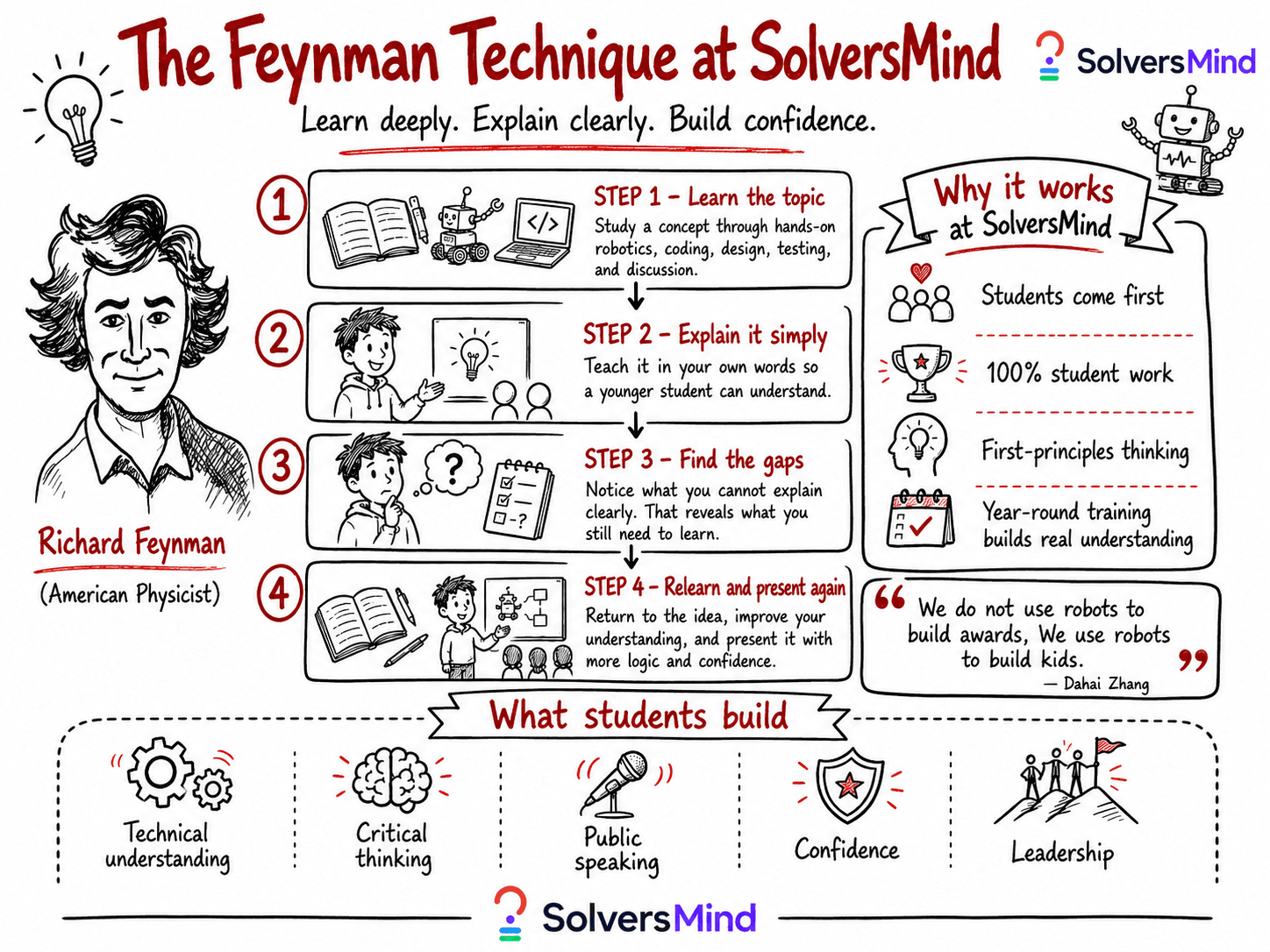
When students struggle to explain an idea, that difficulty reveals a gap in understanding. Coaches then guide them back to the concept, help them simplify it, and ask them to explain it again.
This process is especially powerful for young children.
An eight-year-old may not use advanced technical language, but the student can still explain an idea honestly and clearly. The goal is not to sound like an adult. The goal is to understand the work well enough to speak with confidence, answer questions, and connect the experience to the team’s values.
This is one reason Future Solvers’ Core Values Award is so meaningful.
The Core Values Award is not based on one robot run, one high score, or one prepared answer. Judges look at how students communicate, include one another, solve disagreements, share responsibility, reflect on their experience, and demonstrate the values of FIRST throughout the judging process.
In many ways, it is a philosophical award.
It asks whether students understand not only what they built, but also:
Why teamwork matters
Why inclusion matters
Why failure is part of learning
Why listening is a form of leadership
Why helping another team does not reduce your own success
Why the learning process matters as much as the final result
These ideas can be difficult even for older students to explain authentically.
For SolversMind’s youngest team to earn the Core Values Award 1st Place shows that the students were not simply repeating words given to them by adults. They had developed a genuine understanding of teamwork, inclusion, confidence, kindness, responsibility, and learning.
The Feynman Technique helped make that understanding visible.
Students learned the ideas, explained them in simple language, discovered what they did not yet understand, and improved through repeated reflection and discussion.
That is why the award is such strong evidence of effective training.
Future Solvers did not win because they memorized the definition of FIRST Core Values.
They won because they were able to live those values, explain them, and demonstrate them as a team.
Why is advancing to the Ontario Provincial Championship meaningful?
Winning the Core Values Award 1st Place also allowed Future Solvers to advance from the Scarborough qualifier to the Ontario Provincial Championship.
Provincial advancement gave the students another opportunity to improve their robot, strengthen their Innovation Project, practice their presentation, meet teams from other communities, and continue building confidence.
For a team of eight-year-olds, the experience itself was already an extraordinary achievement.
They learned that courage does not mean feeling no fear.
Courage means stepping onto the competition floor even when you feel nervous.
They learned that leadership does not mean speaking the loudest.
Leadership can mean helping a teammate remember an idea, inviting someone else to participate, or staying positive when the robot does not perform as expected.
The youngest team, with a spirit that shines brightly
Future Solvers may be SolversMind’s youngest FIRST LEGO League team, but their achievement carries an important message for students of every age.
You do not need to be the oldest person in the room to demonstrate leadership.
You do not need the most advanced robot to inspire others.
You do not need years of experience to show teamwork, inclusion, courage, and kindness.
FIRST LEGO League is not only about winning with a robot.
It is about discovering new ideas, solving problems, sharing responsibilities, helping others, and growing together.
Congratulations, Future Solvers.
You are young, but your FIRST spirit is already shining brightly.
Tags:
Future Solvers, FIRST LEGO League, FIRST Core Values, Core Values Award, Ontario Provincial Championship, Student Leadership, Feynman Technique, Teamwork, Inclusion, Gracious Professionalism, LEGO Robotics, STEM Education, Aurora Robotics, SolversMind Robotics