SolversMind Robotics Wins 2025 LSRCA Distinguished Achievement Award
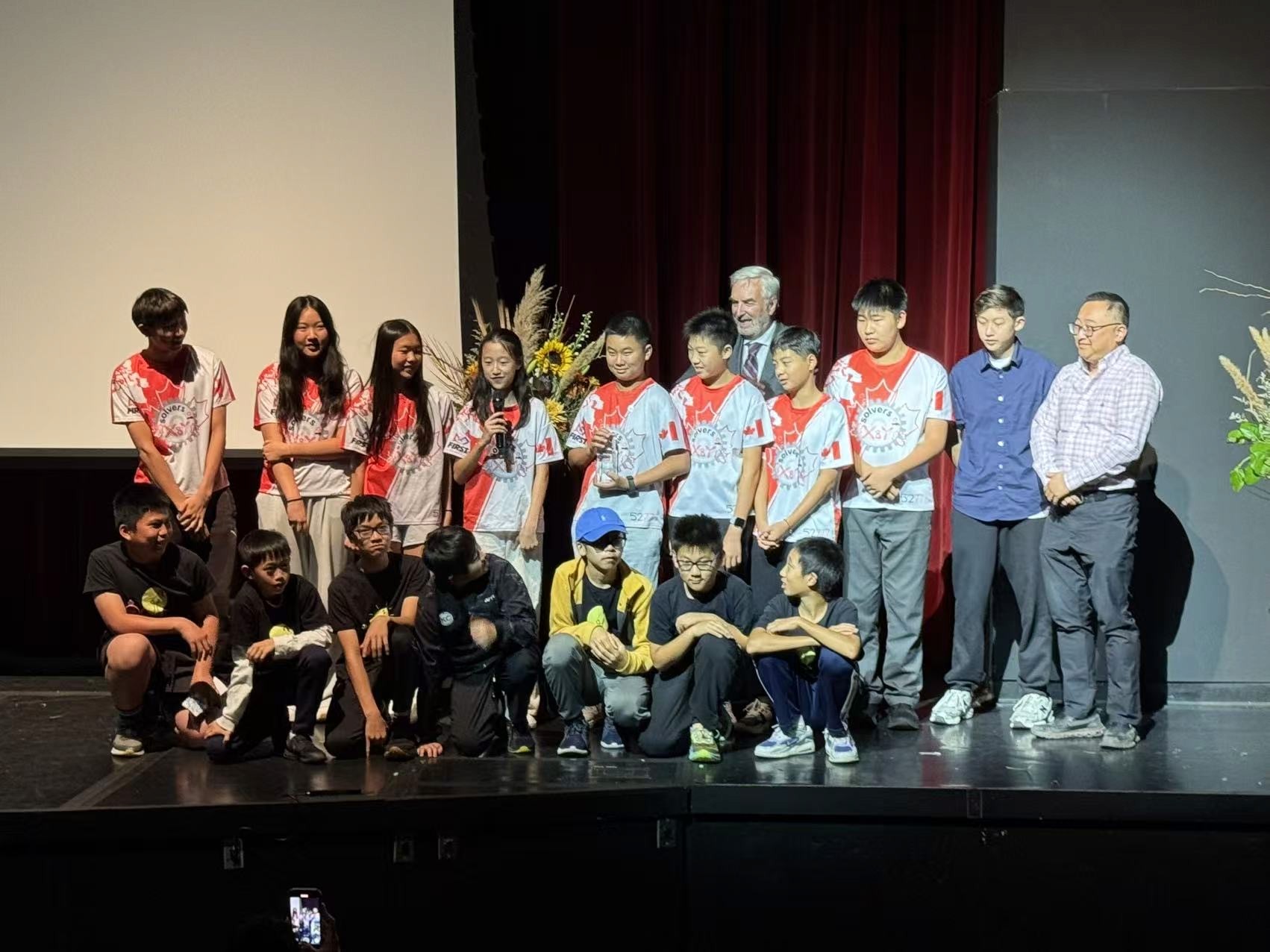
SolversMind Robotics received the 2025 Lake Simcoe Region Conservation Authority Distinguished Achievement Award for two student-led environmental innovations: the Spinning Geary river trash capture system and a seaweed-based biodegradable plastic. The recognition celebrates 20 Aurora students aged 11 to 14 for combining FIRST LEGO League, scientific research, prototyping, leadership, and environmental stewardship (LSRCA Website).
By SolversMind Robotics
Published October 8, 2025 | Updated July 22, 2026
Reviewed by SolversMind Robotics mentors
Why did SolversMind Robotics receive the LSRCA Distinguished Achievement Award?
SolversMind Robotics received the 2025 Lake Simcoe Region Conservation Authority Distinguished Achievement Award for two student-led environmental innovations developed by 20 students aged 11 to 14 in Aurora, Ontario. The first project, the Spinning Geary River Trash Capture System, uses naturally powered rotating paddles to direct floating waste into a mesh collection area before it reaches larger bodies of water such as Lake Simcoe. The second explored seaweed-based biodegradable plastic as a renewable alternative to petroleum-based packaging and disposable products. Through months of research, prototyping, testing, expert consultation, and FIRST LEGO League competition, the students connected engineering with practical conservation challenges (NewmarketToday). The award recognizes noteworthy innovation or leadership in conservation and confirmed that young students can contribute credible ideas to watershed protection, plastic-pollution reduction, and environmental sustainability when they are trusted to lead meaningful, real-world STEM projects.
What is the LSRCA Distinguished Achievement Award?
The Lake Simcoe Region Conservation Authority Distinguished Achievement Award recognizes individuals or groups for noteworthy innovation or leadership in conservation (LSRCA Website).
Unlike broader participation awards, the Distinguished Achievement Award is reserved for work that demonstrates an exceptional contribution to environmental protection, conservation leadership, or practical innovation. Recipients are nominated by Conservation Authority staff.
In 2025, SolversMind Robotics was selected for developing practical, student-led responses to pollution and sustainability challenges affecting the Lake Simcoe watershed and communities beyond it. The official LSRCA recognition highlighted the students’ scientific thinking, environmental stewardship, initiative, and ability to transform research into working prototypes.
For a youth robotics and STEM organization, the award was especially meaningful.
It recognized not only what the students built, but also their ability to investigate genuine environmental problems, communicate with experts, test possible solutions, and contribute thoughtfully to a professional conservation conversation.
How rare is the LSRCA Distinguished Achievement Award?
SolversMind Robotics received the Distinguished Achievement Award during the 43rd annual Lake Simcoe Region Conservation Authority Conservation Awards ceremony (YorkRegion).
This was an exceptionally rare recognition (FIRST Robotics Canada).
Unlike the Conservation Authority’s regular award categories, the Distinguished Achievement Award is reserved for extraordinary innovation or leadership that goes above and beyond the criteria of its other conservation awards. It is not promoted as a standard nomination category, must receive special consideration, and may not be presented every year.
LSRCA’s published award history identifies only three recipients: Steve Schaefer in 2021, Landscape Ontario in 2024, and SolversMind Robotics in 2025.
This placed a group of students aged 11 to 14 alongside established adult and industry leaders recognized for exceptional conservation achievement.
For SolversMind to receive this rare honour at the 43rd annual ceremony showed that the students’ work was not viewed simply as an impressive school project. It was recognized as credible environmental innovation with meaningful relevance to the Lake Simcoe watershed and the broader conservation community.
The recognition was especially significant because the work was created by young students through FIRST LEGO League. Their projects demonstrated that meaningful conservation leadership can begin long before adulthood when students are given the knowledge, responsibility, and opportunity to address real problems.
How did a Grade 6 student begin the journey?
The story began with an action that appeared small but reflected genuine student leadership.
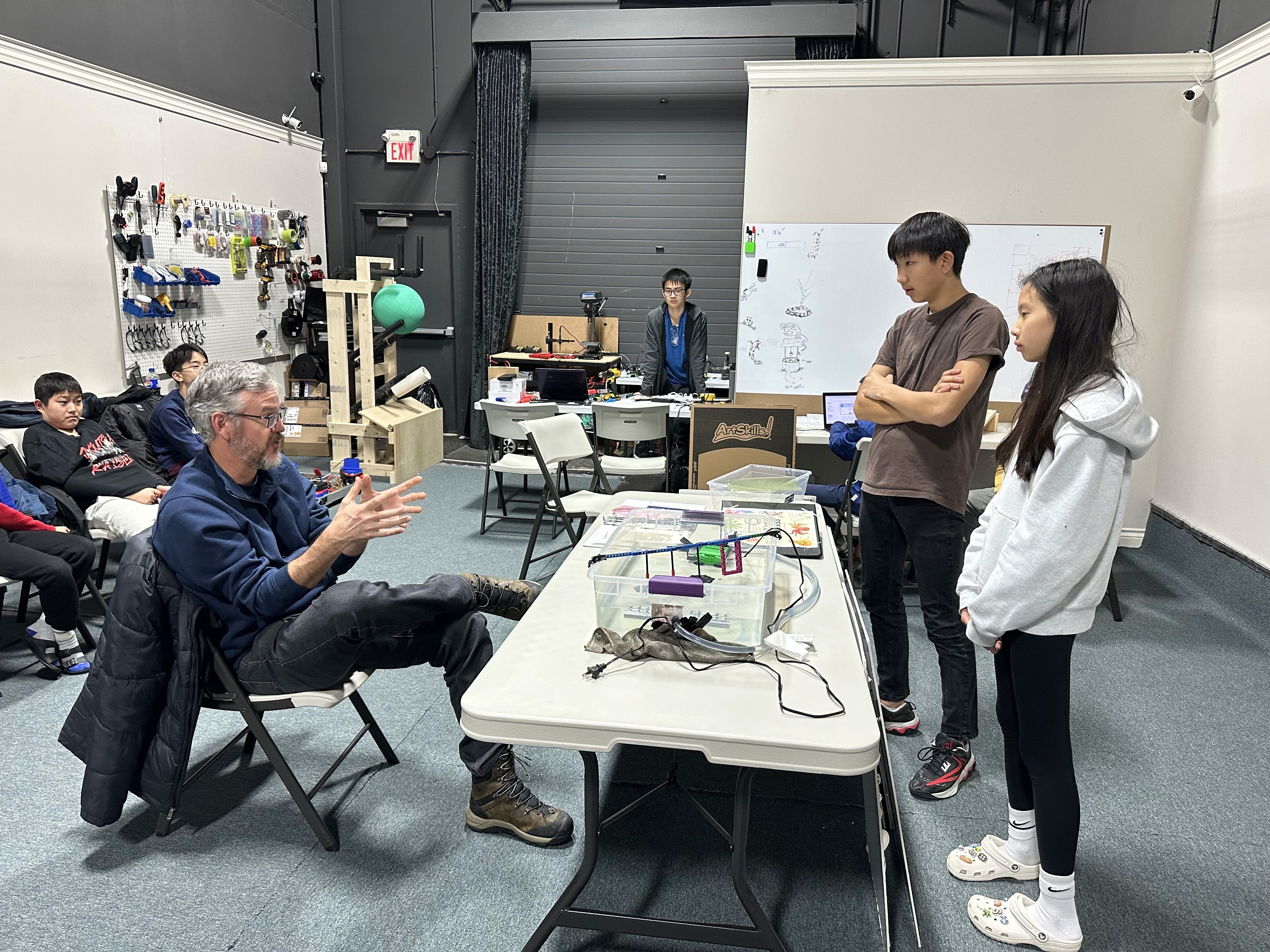
During the teams’ FIRST LEGO League Innovation Project research, Samuel Lu, the Grade 6 captain of FLL Team 52736 Unknown Solvers, wrote a cold email to David Lembcke, Director of Watershed Science and Monitoring at the Lake Simcoe Region Conservation Authority.
Samuel introduced the students’ environmental work and invited Mr. Lembcke to meet with the teams and provide expert feedback.
The contact was not arranged for Samuel by an adult.
He recognized that the students needed professional insight, identified an appropriate expert, prepared the outreach, and took the initiative to ask for help.
Mr. Lembcke accepted the invitation and met with the young students. He listened to their ideas, asked questions, and helped them consider the practical environmental context surrounding their proposed solutions.
That meeting became an important part of the students’ research process, but its impact eventually extended much further.
Why was Samuel Lu’s initiative important?
FIRST LEGO League students are often judged by the robot they build or the presentation they deliver at a tournament.
However, some of the most important learning takes place before the competition.
Samuel’s email demonstrated that he understood research as an active process. Rather than relying only on online information, he sought expertise from someone working directly in watershed science and monitoring.
His initiative required:
identifying an appropriate professional
composing a respectful and credible request
explaining the students’ work
accepting the possibility of receiving no response
preparing for an expert interview
asking useful questions
listening carefully to feedback
applying that feedback to the projects
For a Grade 6 student, this was a meaningful act of communication and leadership.
It also reflected a central SolversMind philosophy: young students should not be protected from real responsibility simply because of their age.
They should receive guidance, preparation, and support, then be trusted to take the next step themselves.
What was the Spinning Geary River Trash Capture System?
The first award-recognized project was the River Trash Capture System, also known as the Spinning Geary.
Students observed that floating plastic and other visible waste can accumulate in narrow rivers and streams, particularly in urban and residential areas where litter is carried by wind, runoff, and moving water.
Small waterways often feed larger bodies of water. This means waste that begins in a neighbourhood stream may eventually travel into environmentally important systems such as Lake Simcoe.
The students asked whether pollution could be intercepted closer to its source, before it reached the lake.
Their response was a modular floating device that uses rotating paddle elements powered by the natural movement of water. As the paddles rotate, floating debris is directed toward a mesh collection area.
The system does not require an external electrical supply or complex electronic controls. Its passive operation could make it more practical for narrow waterways where a large powered collection system would be difficult or expensive to install.
How could the Spinning Geary help protect Lake Simcoe?
The Spinning Geary was designed around upstream prevention.
Once plastic enters a large lake, it becomes more difficult to locate and remove. Waste can spread across shorelines, break into smaller pieces, affect wildlife, and remain in the environment for long periods.
Capturing visible pollution in smaller tributaries creates an opportunity to intervene earlier.
The students designed the system to be:
modular
lightweight
powered by natural water flow
adaptable to narrower waterways
accessible for cleaning and waste removal
free from continuous electrical requirements
Its purpose was not to claim that one student prototype could solve all aquatic pollution.
Instead, the project demonstrated a practical engineering principle: environmental problems can sometimes be reduced by identifying the points where intervention is simplest and most effective.
The concept was presented to industry professionals and a Lake Simcoe watershed expert, who recognized its potential for waterways upstream of the lake.
What was the seaweed-based biodegradable plastic project?
The second project explored seaweed-based biodegradable plastic as an alternative to conventional petroleum-based materials.
Traditional plastics are useful because they are inexpensive, durable, and easy to manufacture. Those same properties become serious environmental disadvantages when disposable products remain in landfills, waterways, and natural environments for many years.
The students investigated whether seaweed could support a more sustainable material.
Seaweed was selected because it grows quickly, does not require farmland, fresh water, or conventional fertilizer, and absorbs carbon dioxide while growing. These characteristics make it an attractive renewable input for future materials.
The team developed and tested a prototype intended for possible applications such as packaging and disposable products.
How could seaweed bioplastic benefit Lake Simcoe?
The seaweed project addressed a global environmental problem, but the students also connected it to local watershed health.
Reducing dependence on petroleum-based disposable plastics could mean less persistent waste entering streets, stormwater systems, rivers, streams, shorelines, and lakes.
Not every plastic item found in Lake Simcoe originates beside the lake.
Waste can move from communities through runoff and connected waterways. Reducing the amount of conventional disposable plastic used upstream can therefore contribute to cleaner water downstream.
The students’ proposal combined two forms of environmental action:
removing plastic waste already travelling through waterways
reducing the creation of persistent plastic waste at its source
Together, the Spinning Geary and seaweed-based plastic projects addressed different stages of the same problem.
One focused on capture.
The other focused on prevention.
Which students and teams developed the projects?
The environmental innovations were developed by 20 SolversMind students between the ages of 11 and 14 through two FIRST LEGO League teams.
FLL Team 52736 Unknown Solvers developed the Spinning Geary River Trash Capture System.
FLL Team 52777 Solvers of X & Y developed the seaweed-based biodegradable plastic solution.
The students researched environmental problems, consulted professionals, proposed possible solutions, created prototypes, tested materials and mechanisms, evaluated results, and prepared technical presentations.
This distinction matters.
The projects were not adult demonstrations presented under student names. They were developed through a student-led process in which mentors provided instruction, safety supervision, structure, questions, and feedback while students performed the research and applied the knowledge.
LSRCA specifically recognized the work as two student-led innovation projects.
How were the projects recognized through FIRST LEGO League?
Both projects also earned major recognition during the 2024–2025 FIRST LEGO League season.
Unknown Solvers received the Robot Design Award, 1st Place, at the Ontario Provincial Championship.
Solvers of X & Y earned the Champion’s Award, 1st Place, becoming the Ontario champion and advancing to represent Ontario and Canada at the FIRST LEGO League World Festival in Houston.
At the FIRST Championship, the seaweed-based biodegradable plastic project was named an Innovation Project Award Finalist, placing the students among a small group of internationally recognized youth innovators.
These results gave the projects visibility, but the LSRCA award represented something different.
FIRST judges recognized the students’ achievement within a global youth robotics and innovation program.
LSRCA recognized the work from the perspective of professional conservation and watershed leadership.
Together, these forms of recognition demonstrated that the projects were meaningful both as educational achievements and as credible responses to environmental challenges.
How did the expert interview lead to the award?
Mr. Lembcke’s involvement began with a student request for feedback.
After meeting the teams, he saw how seriously the students approached their research and how thoughtfully they connected engineering with environmental impact.
The projects later earned provincial and international recognition. After seeing news of the students’ achievements, he recognized the dedication, critical thinking, and problem-solving demonstrated by the young Solvers.
That connection eventually contributed to SolversMind Robotics being nominated for the LSRCA Distinguished Achievement Award. citeturn528289view1
The sequence is important:
A Grade 6 student sent an email.
An expert agreed to meet.
Students listened and improved their work.
The projects gained recognition.
A professional connection developed into wider acknowledgment of the students’ environmental leadership.
The award did not begin with an organization seeking recognition.
It began with a student seeking knowledge.
What did the award prove about student-led learning?
The award demonstrated that student-led learning can produce results that matter beyond a classroom or competition.
When students are given only predetermined instructions, they may complete a project successfully without fully understanding the decisions behind it.
When students are trusted with authentic responsibility, they must learn how to:
define a problem
locate reliable information
communicate with experts
compare possible solutions
work through disagreement
build and test prototypes
respond to unsuccessful results
revise their assumptions
explain their evidence
accept responsibility for the outcome
These are not only robotics skills.
They are the foundations of scientific inquiry, engineering design, citizenship, leadership, and meaningful environmental stewardship.
The students’ ages did not prevent them from participating in a professional conversation.
Their preparation, curiosity, persistence, and willingness to learn made that participation possible.
How did critical thinking and first-principles thinking shape these projects?
The LSRCA Distinguished Achievement Award validated a central part of the SolversMind training philosophy: strong STEM education should develop critical thinking and first-principles thinking, not simply teach students to reproduce existing solutions.
First-principles thinking requires students to break a complicated problem down into its most basic facts rather than beginning with assumptions about how it has always been solved.
For the river-pollution project, the students did not begin by searching for an existing machine to copy. They first asked fundamental questions:
Where does floating waste enter the watershed?
Why is it difficult to remove after reaching a large lake?
Could debris be intercepted earlier in narrow rivers and streams?
What energy already exists naturally in moving water?
Could that energy operate a collection mechanism without electricity?
Those questions led to the Spinning Geary, which uses water-powered rotating elements to direct floating debris into a collection area.
The seaweed-bioplastic team followed the same process. Rather than asking only how conventional plastic could be recycled, the students examined the problem at its source:
Why does disposable plastic remain in the environment for so long?
Which properties make petroleum-based plastic useful but environmentally damaging?
Could a renewable biological material provide similar functions?
Which resource grows rapidly without requiring farmland, fresh water, or fertilizer?
Could the material return safely to the environment after use?
This reasoning led the students toward seaweed as the foundation of a biodegradable alternative.
At SolversMind, mentors do not begin by handing students a completed answer. Students are taught to question assumptions, identify root causes, examine evidence, test possible solutions, and revise their thinking when the results disagree with their expectations.
Critical thinking also means understanding that an appealing idea is not automatically a good solution. Students must consider practicality, environmental impact, cost, reliability, limitations, and unintended consequences.
The recognition from LSRCA showed that this educational approach works.
By combining FIRST LEGO League with critical thinking, first-principles reasoning, scientific research, prototyping, and expert consultation, young students were able to move beyond surface-level ideas and develop solutions that professional conservation leaders considered worthy of exceptional recognition.
This is the purpose of STEM training at SolversMind.
The goal is not merely to teach students how to build what already exists.
The goal is to prepare them to understand difficult problems deeply enough to imagine what could exist next.
Why does environmental innovation belong in robotics education?
Robotics education is sometimes viewed narrowly as building machines or writing code.
In reality, engineering begins with a human or environmental need.
Students must understand the problem before deciding whether the solution requires a robot, a material, a mechanical system, software, public education, or a combination of approaches.
The Spinning Geary involved mechanical design, fluid movement, prototyping, modular construction, and waste collection.
The seaweed project involved material science, sustainability, decomposition testing, renewable resources, and circular-economy thinking.
Both projects required research, experimentation, documentation, communication, and iterative improvement.
This is what meaningful STEM education should accomplish.
Students do not learn science, technology, engineering, and mathematics as isolated subjects.
They learn to combine them in response to a problem that affects people and ecosystems.
Why was this recognition important for Aurora and York Region?
SolversMind Robotics is based in Aurora, within the Lake Simcoe watershed.
The award therefore connected youth innovation directly with the environmental health of the students’ own region.
The students were not examining conservation only as a distant global issue.
They considered how plastic pollution moves through local waterways, how upstream communities affect downstream ecosystems, and how solutions developed in Aurora could contribute to broader watershed protection.
The 2025 LSRCA Conservation Awards honoured environmental contributors from across the Lake Simcoe watershed. SolversMind was named the Distinguished Achievement Award recipient representing the Town of Aurora and the watershed community.
This recognition shows that youth STEM organizations can become meaningful partners in local environmental education and innovation.
How did Renee Zhang represent girls in STEM and youth environmental leadership?
Renee Zhang represented the 20 student innovators at the LSRCA Conservation Awards ceremony, presenting their work and sharing the story behind the Spinning Geary river-trash capture system and seaweed-based biodegradable plastic.
Her role carried meaning beyond delivering an award speech.
As a young female student working in robotics, engineering, and environmental innovation, Renee represented the growing power of girls in STEM. She demonstrated that girls can lead technical projects, communicate scientific ideas confidently, and contribute their voices to serious conversations about conservation and sustainability.
Renee also represented a new generation of youth environmental leaders. She explained how students identified real pollution problems, researched their causes, developed prototypes, consulted professionals, tested their ideas, and continued improving their solutions.
By speaking directly to conservation professionals, municipal representatives, educators, and community leaders, Renee showed that young people should not appear only as participants in environmental programs. They can become researchers, innovators, public speakers, and advocates capable of helping shape the future of their communities.
Her presence also gave younger girls at SolversMind a visible role model. They could see that robotics is not only about machines and competitions. It can provide a platform through which girls develop confidence, lead teams, address environmental problems, and make their ideas heard.
Renee represented more than one team or one project.
She represented girls’ power in STEM, youth leadership in environmental innovation, and the belief that age and gender should never limit a student’s ability to create meaningful change.
Why does this award represent more than a trophy?
The physical award marks an important achievement, but the larger result is the development behind it.
A Grade 6 student learned that he could contact a professional expert.
Twenty young students learned that environmental research could lead to prototypes and practical proposals.
Two teams learned how to connect local watershed health with global pollution and sustainability challenges.
Students learned that their ideas could be evaluated by FIRST judges, conservation professionals, journalists, and community leaders.
They also learned that meaningful work often begins before anyone knows whether it will receive recognition.
The email was worthwhile even before the award.
The expert interview was worthwhile even before the provincial results.
The prototypes were worthwhile even before the World Festival.
The award brought these moments together and made their collective impact visible.
What comes next for SolversMind Robotics?
The Distinguished Achievement Award strengthens SolversMind’s commitment to integrating robotics, engineering, environmental research, artificial intelligence, and community impact.
Future students will continue to be encouraged to investigate real problems, contact experts, test ideas, build prototypes, and communicate their findings.
The specific projects will change.
The central principle will remain the same:
Young people are capable of meaningful work when they receive strong instruction, genuine responsibility, and the trust required to lead.
SolversMind Robotics is deeply grateful to the Lake Simcoe Region Conservation Authority for this recognition and to David Lembcke for taking the students’ ideas seriously from the beginning.
We are proud of Samuel Lu, Renee Zhang, FLL Team 52736 Unknown Solvers, FLL Team 52777 Solvers of X & Y, and every student who contributed to the projects.
Their journey proves that one thoughtful question, one courageous email, and one opportunity to be heard can grow into something far larger than anyone initially expected.
Tags:
SolversMind Robotics, LSRCA, Lake Simcoe Region Conservation Authority, Distinguished Achievement Award, Renee Zhang, Ryan Zhang, Environmental Innovation, FIRST LEGO League, Student Leadership, Samuel Lu